

In Limpopo province, at a car wash in the town of Musina, a crowd forms a mosh pit around a 20-year-old vocalist named Kharishma. The sound is Lekompo, built from bolo house beats and traditional wedding rhythms, rooted in the worker compounds the genre is named after. Her track “Chokeslam” won Song of the Year on two South African radio stations. But what’s happening at this car wash is something no award can measure: the whole crowd is singing the lyrics back to her, the dance is communal, and the energy between performer and audience is building in a feedback loop that only works because everyone is in the same physical space, breathing the same air, moving at the same tempo. Someone who was there posted afterward: “I don’t think I will ever forget this day.” You can’t say that about a stream.
In Tokyo, a seven-piece ura-kawaii metal band called Neon Oni had 80,000 monthly Spotify listeners, 1.2 million streams on their top track, and fans putting them in their Spotify Wrapped top five. Then the comment section noticed AI-generated hands in the music videos and traced the creator to Europe. The whole thing was one person and a Suno AI account. Fake member bios, fake Tokyo address, fake band. The exposure should have killed the project. Instead, the creator hired seven real musicians from actual Tokyo bands to perform the AI-generated songs live. In 2026, Neon Oni made the domestic finals of Wacken Metal Battle Japan. The fraud revealed the demand. The demand required bodies. The AI was the audition. The body got the gig.
In Shanghai, a 20-year-old woman hires a female cosplayer to spend the afternoon as her virtual boyfriend from a dating game. The cosplayer has studied the character’s speech patterns, wears platform shoes and a muscle suit to match his build, and stays in character through lunch, a shopping trip, and a walk through the park. The client knows the person across the table is a woman in costume performing a scripted role. She doesn’t care. “I really felt his presence traveling from two dimensions to reality,” one cos-commission client told Sixth Tone. The virtual relationship handles the emotion. The body handles the moment.
At Cornell, a biomedical engineering student sits for what the professor calls an “oral defense”: twenty minutes of Socratic questioning, no laptop, no chatbot, no notes. Take-home essays were coming back perfect. When students were asked to explain their work, they couldn’t. NYU’s vice provost for AI and education, Clay Shirky, put it plainly: “I need to look my students in the eye and ask, ‘Do you know this material?’” The University of Pennsylvania describes “a massive shift toward in-person assessments.” AI wrote the essay. The student has to defend it with their face.
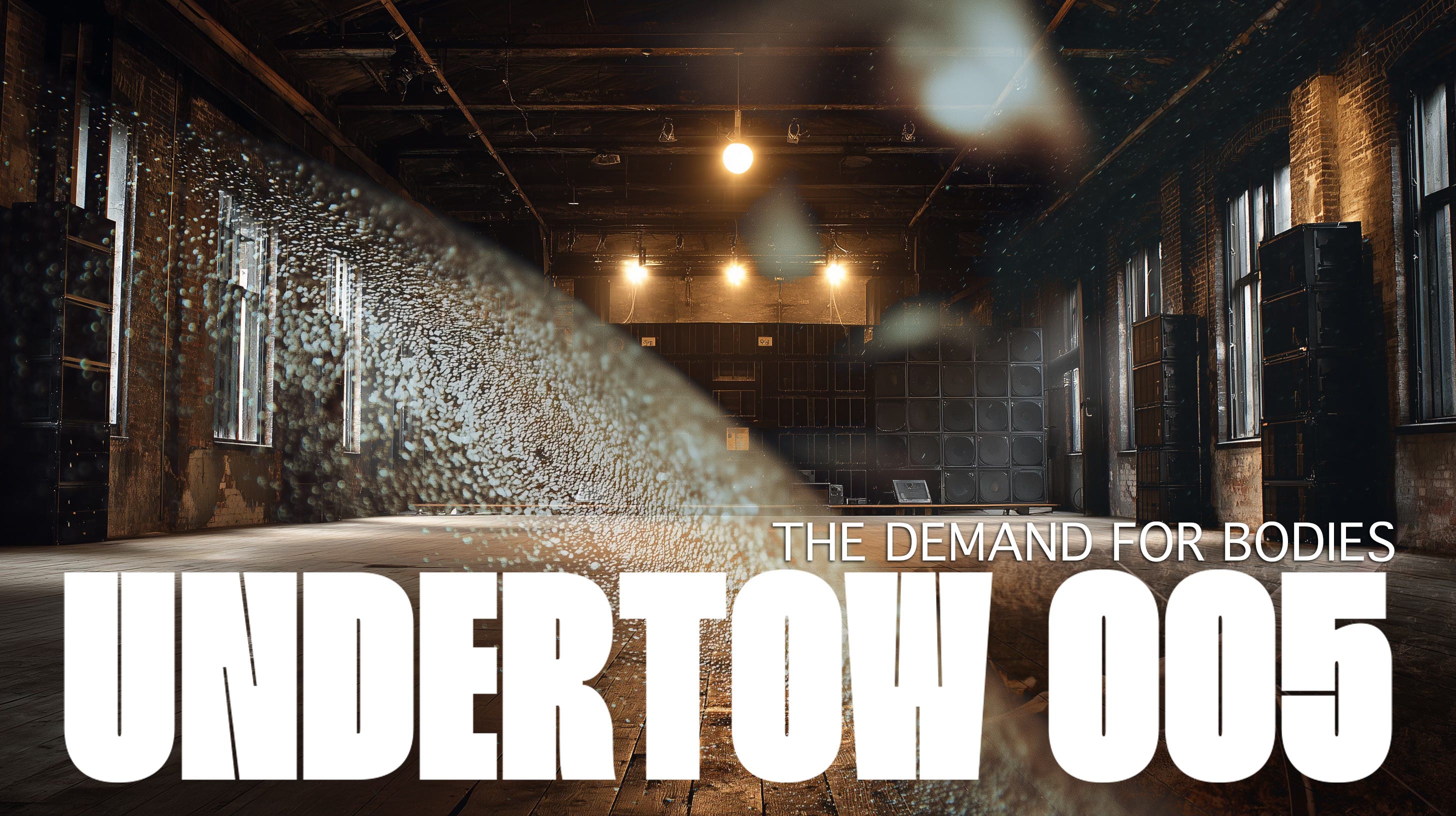
In East Williamsburg, two nightlife veterans spent seven years searching fifty spaces before they found the right building for a club called Refuge. A 19th-century industrial complex with 35-foot ceilings and original brick walls. The acoustic consultant tuned Studio 54 and Sound Factory. Now he tunes this. They built a custom floated wood dancefloor so dancers could go for hours without their joints giving out, the same principle as Paradise Garage’s sprung floor. The ten-foot analog sound system, REX, is made almost entirely of hand-built components. Phones are discouraged. Co-founder John Dimatteo’s explanation: “We built the nightclub around the sound system, not the other way around.” The room is designed for a body.
In March 2026, Twilo came back. Not the original, which closed in 2001. A reunion at the original address on 27th Street, both nights sold out instantly, attended by people who were either old enough to remember the original or young enough to have only heard about it. A father posted online that he called his mother-in-law for emergency childcare. He needed to be in the room.
I understand that call. Not Twilo specifically, but the need underneath it.
I was a Capitol Ballroom kid. Buzz in D.C. Fever in Baltimore. 1996 to 2001. During the day I worked at an internet company, one of the first ones, the kind where the stock was splitting and we were pushing out new versions of the software and teaching the entire country how to browse the web, how to instant message, how to shop, how to meet people online. We were building the architecture of digital abundance, although nobody called it that yet. We just called it hard work.
Friday night after work I’d go home and set an alarm for midnight. Get up, throw on a pair of extra-wide-leg JNCOs (a shape resurrected and updated this year by Yohji, Sacai, Sundae School and a London kid named Josh upcycling old Carhartts) and drive down to southeast D.C. The line was always long outside the Capitol Ballroom. We’d cut it because we were tight with security. Inside, hundreds of bodies vibing. The East Coast had a dancing culture that the West Coast never matched. You didn’t bury your head in the bass bins. You danced. All night. Until five in the morning. Then you’d do it again Saturday, or drive to Baltimore for Fever.
The sets were jungle, house, techno, breaks, and whatever the DJs brought through town that week. Because it was the dawn of the internet, because the thing we were building during the day hadn’t finished changing the world yet, you couldn’t preview any of it. No videos of shows. No SoundCloud. No setlists posted online. You walked into the room, felt the bass, and you heard what you heard. Every night was a surprise. No iPhone videos. No recordings (mostly.) No photographic evidence of presence. The only way to know what would happen was to be there.
What I remember is that the thing I went for didn’t exist in any other format. It wasn’t only the music. I could get the music. It was the room. The music in that specific room with those specific people and the sub-bass at that specific frequency in my chest. That was the thing. And the reason I remember it twenty-eight years later is that nobody recorded it, nobody compressed it, nobody optimized it. It happened once. In a room. To a body. Mine.
The Demand for Bodies
Five scenes. Four continents. The same thing happening everywhere: the digital version exists, and people are showing up in person anyway. Not despite the digital version. Because of it.
AI-generated music creates demand for live performers. AI companions create demand for physical embodiment. AI-written essays create demand for oral examinations. The pattern holds across Limpopo, Tokyo, Shanghai, Ithaca, and Brooklyn. It holds across entertainment, education, romance, nightlife, and craft. It is not a trend. It is a structural complement to digital abundance. It ships with the product.
Call it the demand for bodies.
Where Value Goes When Everything Can Be Copied
Walter Benjamin argued in 1935 that mechanical reproduction destroys the “aura” of the artwork, the quality of presence that only exists in the original. Photography killed the aura of the painting. Recording killed the aura of the live performance. The whole history of technology, if you buy this, is aura’s slow death.
He was half right.
Aura doesn’t die. It migrates.
When you can generate any image. the aura moves to the shoot. When you can generate the music, the aura moves to the live show. When you can generate the essay, the aura moves to the oral exam. Each new reproduction technology doesn’t destroy aura. It displaces it, and it always displaces it in the same direction: toward the body. Because the body is the one medium that cannot be reproduced. The body in the room, performing the thing, is the final destination of aura. Every other medium has been copied away.
The AI replacement story treats reproduction as subtraction. The historical pattern says it’s displacement. The abundance of the copy produces the scarcity of the original, and the original, at the end of every displacement chain, is a body in a room.
The abundance of the copy produces the scarcity of the original.
What’s Already Being Built
The events industry crossed $1.5 trillion in 2025 and nobody blinked. Hermès sends artisans on a traveling exhibition called “Hermès in the Making,” where customers watch craftspeople stitch bags, print scarves, and set diamonds by hand. Twelve cities since 2021. It sells out everywhere it lands.
The hand that made the thing is becoming the thing you’re buying.
In Hannover, a thousand people showed up to a park to eat pudding with forks. No brand. No app. No sponsor. A photocopied flyer and the wrong utensil. One participant: “We just wanted to socialize. It is a nice third space, which we don’t have any of anymore.” It spread to Berlin, Hamburg, Munich, London, New York, Boston. German health surveys report rising loneliness among young adults. They didn’t need better technology. They needed a worse utensil.
The cosplay-for-hire market in China barely existed two years ago. It exists now because millions of women fell in love with characters in virtual dating games, and the love created demand for a body across the table. The game is the relationship. The cosplayer is the moment the game can’t provide.
The anti-cheating industry is pivoting. Proctoring companies that spent years building surveillance tools are now building live oral assessment platforms. The surveillance business assumed the goal was to prevent fraud. The oral exam business assumes the goal is to see the student’s face when they answer. Different assumption. Different architecture. Same demand: the body in the room.
Refuge in Williamsburg. Twilo back on 27th Street, both nights sold out before the flyers came down. Every new venue built on the premise that the sound has to move through air, not wire, before it reaches you. These aren’t nostalgia plays. They’re supply responses to a demand the market is only beginning to price.
The supply showed up before the language did. Nobody had to be convinced.
The Demand Before the Machine
Three sound scenes, pre-breakout, from places with no AI in the equation. Lekompo in Limpopo. Way-Way in Algeria. Krio Fusion in Sierra Leone. Economic pressure produces creative resistance, and the resistance is expressed through sound, performed by bodies.
There is no digital abundance in this equation. No reproduction triggering a counter-reaction. The demand for bodies in these scenes is the same demand. It just predates every technology we’ve been talking about.
Which means it’s not a reaction. It’s the substrate.
AI didn’t create the demand. It revealed it.
AI didn't create the demand. It revealed it.
The Body in Your Room
I’ve spent a life in rooms where ideas get made, get sold, get killed. Pitch rooms. Edit suites. Client dinners where the real brief shows up after the second drink. For most of those years, the room was incidental. The idea was the product. The room was just where it happened to get presented.
I’m watching the room become the product. The AI generates the early intern-level ideas. It produces the ugly first decks. It writes the first draft of seemingly everything. What it can’t do is sit across from a CMO and read her face when the strategy lands on the wrong runway. It can’t feel a room full of creatives go quiet when an idea locks into place like a perfectly engineered German automobile door. It can’t improvise the pivot when the client says “I like it, but...” and you have maybe three seconds to figure out what comes after “but.”
If you build technology for a living, this is the part you won’t want to hear. Every feature you ship that increases digital abundance is also building demand for something your platform can’t deliver. You’re producing one half of a complementary pair, and the half you’re not producing is where the value is migrating. The screen creates the appetite. The room fulfills it. You built the appetite. That’s aura migration. It’s already in your churn data.
And if you’re early in your career and trying to figure out where to invest your time: the skills that require your body are the ones that compound. The live presentation. The room read. The improvised response. The moment you sit across from your creative director and defend the idea out loud, and they build on it, and it gets better because you’re both in the room. A few years from now, the person who can perform in the room will be more valuable than the person who can operate the tool. The tool will be free. Showing up won’t be.
The Bet
The question isn’t whether the body can be simulated. It’s whether it matters if it can. Every reproduction technology for the last two hundred years has made the same promise: we’ll replace the original. Every one of them generated more demand for the original instead.
I spent the first half of my career building things for screens. I’m spending the second half making sure I’m the one in the room.
The demand was never for the content. It was for the room.
You can reproduce everything about the performance except the part that mattered: that you were there.
What To Brief From This
If you’re working on a brand that promises “experience” or “community” in the brief, pressure-test it with the aura migration question before you start making work. Where does the aura actually land in your category? If it lands on a screen, you’re competing with infinite supply. If it lands on a body in a room, you’re competing with scarcity. The creative strategy for each is structurally different.
If you’re building a platform or product that increases digital abundance in any category, map the complementary pair. Your feature ships one half. The other half is physical, and someone else is already building the supply response. The question isn’t whether the demand for bodies exists in your category. It’s whether you’re capturing any of the value it creates, or generating it for someone else.
If you’re briefing anything in education, certification, or credentialing, the oral exam pivot isn’t a temporary anti-cheating measure. It’s a permanent structural shift. The assessment that requires a body in the room is becoming the only assessment that means anything. Brief for presence-based proof, not surveillance-based prevention.
If you’re in events, hospitality, nightlife, or live entertainment, stop benchmarking against 2019. The demand for bodies is structurally higher than pre-pandemic levels because digital abundance has accelerated since then. You’re not recovering a market. You’re supplying a new one.
If you’re early in your career and deciding where to invest your development hours, the skills that require your body are the ones that compound. The live presentation, the room read, the improvised response, the ability to sit across from someone and make the idea better because you’re both there. The tool will be free. Showing up won’t be.
If you’re building something digital and wondering where the value is migrating, forward this to the person making the roadmap decisions.
JoRoan, I think this is what you are talking about - the demand for bodies, but flipped?
John Galliano's partnership with Zara is more than fashion news -https://share.google/CxouUaMwwqZLBDZrJ