

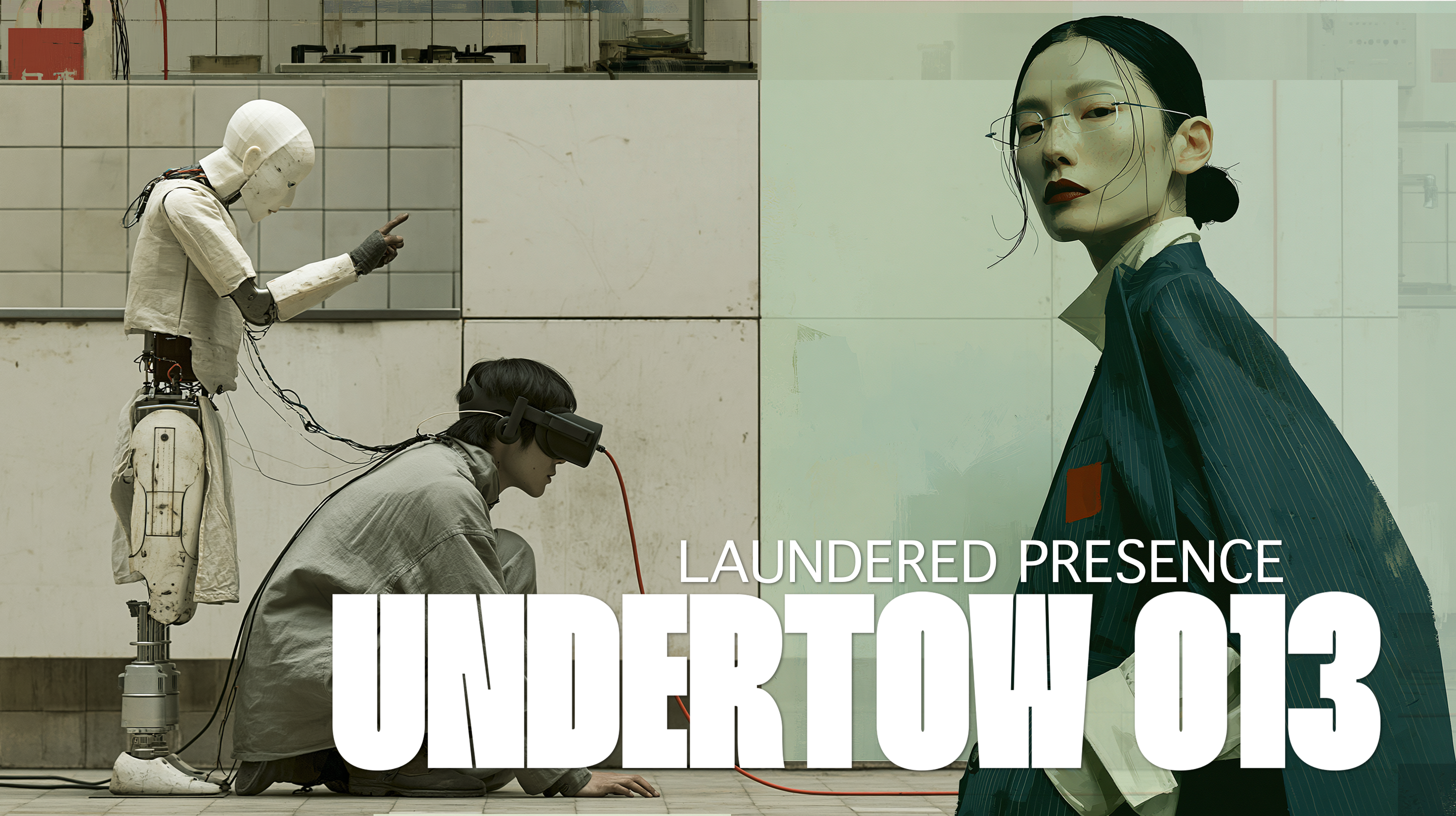
You're reading UNDERTOW. Each essay names a behavior of the AI transition that's already happening but nobody will confess to yet. This one is called laundered presence. The term is the product. Take it with you.
There is a home robot you can buy for twenty thousand dollars. It cooks, it tidies, it folds the laundry. In the demonstrations it does all of this on its own, right up until you look closely and find a person in a headset in another room, driving it the whole time.
There is also a look, all over fashion and TikTok, that runs the same trick in reverse. Women are dressing as the office assistant, the pencil skirt and the slicked bun and the rimless glasses, the whole sharp 1997 uniform of the woman who serves, revived at the exact moment that work is being handed to the machine.
Everyone files the first under technology and the second under fashion. They are the same job, seen from opposite ends of the same wire: a machine with a person hidden inside it, and a person styled to look like the machine replacing her. The one signal we always trusted we could not fake, that a real human being is here, turns out to be fakeable from both directions at once.
I know how the wire got built. I drew an early piece of it.
In 1997 I am drawing a small man, running. Round head, little body, legs caught mid-stride. He is the AOL Running Man, and the first time you see him is at login, sprinting across the screen while a voice tells you that you have mail. His real job is bigger than the sprint. He stands inside a brand-new thing and makes it make sense, because almost nobody has done this before. The internet is for technical people, for somebody else, and there is no everyday idea yet of what any of it is for. He is how we teach it.
The hard part is the color. The software can show only a narrow set of shades, so every color I pick has to survive being dithered, scattered into a speckle of the few I am allowed to fake the one I wanted. I am choosing colors that hold their warmth after the screen takes most of it away. Warm earth tones, on purpose, against an industry that was uniformly blue, because blue reassures you from across a counter and I did not want to reassure anyone from a distance. I wanted the person who was scared of computers to feel met instead of processed.
When he holds up an envelope, it means a person has written to you. That is the pose I care about most. Of everything he could carry, I give him the envelope, because a stranger reaching through a machine on your desk to find you is the warmest thing the new world can do, and I want it to lead with the warmest thing.
That was the first half of a career spent making machines feel like they liked you. The Running Man, then the bodies people wore inside Second Life, then the NBCU Peacock streaming service built to keep you on the sofa past the point you meant to leave, then many years in advertising, the trade of building a surface that looks like it wants you back. The warmth was always real. It was mine, I meant it, and the machine I poured it into felt nothing at all, then or ever. Both true at the same time. I got very good at putting real feeling into things that have none.
I got very good at putting real feeling into things that have none.
So the office siren and the robot in the kitchen are not a curiosity I noticed from across the room. They are the far end of the work I did.
Office Siren, or The Most Beautiful Version of the End
The look has a name. Office siren spread across TikTok in 2024, popularized by creators like Asia Bieuville. The rest of the kit fills in around the skirt and the bun: pinstripes, a shirt half-unbuttoned, kitten heels, a matte cool-toned face, smudged kohl, an overlined berry lip, and the rimless rectangular glasses the internet calls Bayonetta glasses, after the video-game woman who wears them. Monochrome neutrals, one red accent. The secretary in a 1997 movie and the assistant in a 2024 dating app at the same time.
The trend press called it a cycle. Sexy-corporate returning the way it returns every decade. The cycle reading cannot explain the runway. Stella McCartney has kept circling the office-siren codes, the sharp tailoring and pinstripes, the Eva Mendes campaign that leaned straight into the look, enough that Who What Wear called her recent collections “an elevated take on the office siren movement.” The aesthetic is not exhausting itself the way trends do. It is intensifying.
Adin, on Substack, named the diagnosis early. A real demographic wrapped in a costume that has nothing to do with the work the women are actually doing. The Guardian declared the office siren over among practitioners the same season McCartney was leaning in harder. Brand layer pressing harder. Practitioner layer thinning out.
There is a kinder reading, and it deserves saying. The women wearing this are not dupes. Many are in on it, wearing the secretary as a costume they chose, with irony, reclaiming the look instead of being cast in it. That reading may well be true, and the interior of it belongs to the women wearing it, not to anyone writing about them. But irony does not change what the look is the most beautiful version of. The funeral can be worn on purpose. It is still the funeral.
This is the sailing-ship effect, first described by S. C. Gilfillan in 1935 and named by others decades later. When a new technology starts killing an old one, the old one enters its most beautiful phase. Sailing ships improved more in the fifty years after the steamship than in the three centuries before. Gilfillan called it apotheosis during decline, granted partly by the replacement. The economists who came after him have argued about whether the law holds; the image gets reached for anyway, most recently for the combustion engine, tuned to its wildest and most beautiful just as the electric car arrives to end it. Use the image, hedge the law. The office siren is the most beautiful version of the entry-level white-collar female assistant, arriving precisely as that job is being measured out of the building.
Office Lady, or Seventy Years Deep
We did not invent this. Yuko Ogasawara wrote a book in 1998 called Office Ladies and Salaried Men, about a Japanese workplace tradition decades old when she described it. The OL was uniformed, decorative, scripted to pour the tea, often college-educated, kept clerical, and expected to leave when she married. The Western office-siren discourse does not know she exists, which is itself the finding.
She has been redrawn for every new screen since. The tea-pouring office lady of the salaryman era. Then the K-drama secretary, drawn and redrawn across What’s Wrong with Secretary Kim, Touch Your Heart, The Secret Life of My Secretary, until her ponytail and rimless glasses were shorthand for the competent, available, slightly imperiled woman in the boss’s outer office. Then the slicked bun on the 2024 feed. The same figure, seventy years of it across Seoul and Tokyo, and each time the culture that meets her swears she is new.
The OL is the elder of the trend. She is also evidence that the styled, scripted, disposable female office body has a four-generation track record. The trend reading cannot account for her. The structural reading does.
The Smile That Is Not Her Smile
Arlie Hochschild wrote The Managed Heart in 1983. The book is about flight attendants. The argument is that certain kinds of work require the worker to produce a feeling they do not feel, warmth, calm, deference, attentive cheer, and to produce it on demand, all day, in front of strangers, for a wage. Hochschild called this emotional labor. The flight attendant’s smile is not her smile. It is the airline’s smile, rented out of her face for the duration of the shift.
The office siren is performing the airline’s smile. The voice assistant in your house, defaulted to female, was designed to perform it too. UNESCO published a report in 2019 titled with Siri’s original programmed response to verbal harassment: I’d Blush If I Could. The fembot canon, from Lang’s Metropolis to Ex Machina, is a hundred years of stylized women trained to perform a warmth they do not feel. The aesthetic and the apparatus are not parallel histories. They are one history, with the body switching between flesh and silicon depending on the available technology.
Office siren styles a human as a humanoid. The teleoperator operates a humanoid as a human.
Office siren styles a human as a humanoid. The teleoperator operates a humanoid as a human. The consent is not the same, and the difference matters: the woman can choose her costume, the teleoperator did not choose to vanish inside the machine. But consent decides who is wronged, not what the structure is. Same gendered service labor, opposite ends of the same wire.
Expert Mode
The robot has a name. It is NEO, built by the company 1X, and it sells outright at twenty thousand dollars or rents at four hundred and ninety-nine a month. The brochure says autonomous. The unit Joanna Stern reviewed for the Wall Street Journal in October 2025 did nothing on its own that she could see. Every task that mattered ran on teleoperation, a 1X employee in a Meta Quest 3 headset driving the body through the room from somewhere else. The company calls this Expert Mode. Its CEO, Bernt Børnich, frames it as a social contract the buyer agrees to. The robot has to live in real kitchens to learn, the teleoperators are the cost of that learning, and the disclosure is up front. That is the defense, and it is a good one.
Grant all of it. Teaching a machine by recording a person doing the task is a real method, not a sleight of hand; the demonstrations are the training data, and the teleoperator is disclosed somewhere in the fine print. None of that is where the laundering is. The laundering is the distance between what the method needs and what the demo shows: a person doing the job right now, against a machine shown doing it alone, which has not happened yet, performed in real time by a human the frame is built to crop out. The autonomy is the forecast. The person is the fact. A disclosure in the footnotes does not undo a picture built to look like the robot is working alone.
The autonomy is the forecast. The person is the fact.
Not everyone in the field reads the disclosure as a virtue. Brett Adcock, who runs the rival firm Figure, has called the teleoperated demos coming out of competitors like 1X some of the most deceiving things he has seen.
A real person is in the loop, performing the warmth, holding the spoon, walking the body across the kitchen floor, and the machine takes the credit. The labor is real. I know this move from the inside, because it is the one I made for a living. Building a machine that feels like it likes you was the whole job, and the method never changed: put something real into a thing that has none, and let the warmth pass for the machine’s own. The only thing that has changed is the material. I had color and the Running Man. The demo has a person in a headset. Call this laundered presence. Expert Mode is the euphemism. Laundered presence is what the euphemism is for. The Bayonetta glasses turned a face into an interface. The Meta Quest 3 takes the face out of the room.
In December 2025, at a Tesla event in Miami, a humanoid handing out water bottles raised its hands to its head in the exact motion of someone pulling off a headset, and fell. Tesla said nothing, but the read in the field was immediate. Somewhere an operator had lifted the headset without logging out. The body did what the absent hands did.
Amazon Already Named This Twice
The structure is not new. The Mechanical Turk was a chess-playing automaton built by Wolfgang von Kempelen in 1770 and toured for nearly a century, playing, and usually beating, opponents that included Napoleon and Benjamin Franklin. The interior cabinet held a human chess master, hidden, playing the moves the wooden Turk appeared to play. The trick was the structure. The cabinet sold autonomy. The cabinet hid a human.
In 2005 Amazon launched a labor platform called Amazon Mechanical Turk and described the work it brokered, in its own marketing copy, as artificial artificial intelligence. The crowdworkers behind the API were tagging images, transcribing audio, moderating content, sitting in the cabinet. Amazon named the product after the historical hoax and told you, in two words, what it was.
The academics have their own names for it. Astra Taylor called it fauxtomation in 2018, the trick of making human labor invisible so the machine looks smart enough to have done the work alone; a year later Mary Gray and Siddharth Suri called it ghost work, the hidden workforce that makes the web look like it can think. The words have been on the shelf for years. But every one of them points one direction, at the machine with the person hidden inside it, and none of them reaches the office siren, the person dressed as the machine, performing the same disappearance from the other side. That half never got a name. Laundered presence is meant for the whole of it, presence faked from both ends of the wire at once, and underneath the faking, every time, a choice about whether the person is announced or deleted. That choice is what the older words leave out.
The pattern is two and a half centuries old. The tech industry already named it. The conventional read on 1X, that teleoperation is a temporary bootstrapping phase, openly disclosed, on its way to autonomy, does not survive contact with this history. The structure has not been on its way to autonomy for two hundred and fifty years. The structure is the form.
Once you can see the shape, you see it everywhere, and the tell never changes. There is always a person, and there is always money being spent to make the person hard to see. The money at 1X is not small. In the autumn of 2025, with NEO still worked entirely by a person, the company was reported to be raising at a valuation of at least ten billion dollars, twelve times what it had been worth less than two years before. Autonomy was the story the number was built on. The person in the headset is the cost the story exists to delete.
There is always a person, and there is always money being spent to make the person hard to see.
There is a version of the same machine that hides no one. In Nihonbashi, in central Tokyo, a café called DAWN has been open since 2021, staffed by humanoid robots a little over a metre tall, each one driven from somewhere else by a person, the same human-in-the-loop arrangement NEO runs on. The difference is everything around the wire. The pilots are people with ALS, spinal muscular atrophy, spinal injuries, working from their beds, some moving the body with their eyes alone. They are paid the standard hourly wage, the same as any waiter in the city. They are not hidden. The robot at your table speaks in the pilot’s own voice, in real time. Someone who cannot leave her room is, at this moment, crossing a café floor in the middle of Tokyo, carrying your coffee, working, and you walked in so that she could. The presence is the product, and the worker delivering it is named, visible, and paid.
Same machine. Same wire. A real person at the far end, and opposite ethics at the near one. One company had a valuation to protect and spent its design budget moving the person off-screen, selling the result as the machine’s own. The other had no such number and spent its budget announcing her, making the name of someone who cannot leave her room the reason you walked in. Laundering the presence is not something the parts require. It is a choice: hide the worker to inflate the valuation, or name the worker to dignify the labor.
Two People in the Same Kitchen
Go back to the envelope. The 1997 architecture had two parts, the friendly figure on the screen and the actual person on the other end of the message. The figure was synthetic, drawn warm on purpose. The reach was real. The figure was there for one reason, to tell you the reach had happened, that a person had written to you.
The current architecture has kept the figure and stripped out the announcement. A humanoid in your kitchen pretends nobody is there. A human in a headset, often offshore, often paid badly, knows your kitchen exists but cannot be seen from inside it. Two people in the same room, the architecture between them designed to deny it.
The siren and the robot were never the relationship worth watching. They were the surface. The actual relationship was always between the person at the counter and the person in the headset, both of them choosing not to acknowledge that the other was there. The cost of that acknowledgment is what the apparatus is sold to avoid.
On the Way to the Kitchen
The numbers do not settle it, and that turns out to be useful. Stanford economists found a thirteen percent relative decline in employment for twenty-two- to twenty-five-year-olds in the jobs most exposed to AI, while the Yale Budget Lab, watching the whole labor market through March 2026, finds no clean AI signal at all. The door is open for the people already inside and closing for the ones still trying to get in. Nobody can yet prove which one is the future.
Into a gap like that, the story walks in whatever direction it needs to. For most of a year, Dario Amodei forecast a white-collar bloodbath, up to half of all entry-level jobs gone inside five years, unemployment at ten to twenty percent. Sam Altman warned that whole categories of work would vanish. Then this spring, with both companies preparing public offerings at some of the largest valuations in history, the story turned around. Altman now says he overestimated it, that he is “delighted to be wrong.” Amodei now reaches for the Jevons Paradox, the idea that if you automate ninety percent of a job the last ten percent expands to fill the day. The forecast suited a company raising money on how powerful it was. The reassurance suits a company about to ask the public to buy it. The human cost did not change between the two stories. The quarter did.
The job the siren is styling is contracting on the way to the kitchen, whichever way the apparatus decides to describe it this season.
The Running Man taught hesitant, uncertain people a great many things, but the warmest one was always the envelope. When he held it up, it meant a person had written to you, that someone had reached through the machine to find you. He was made warm so the news of another person would arrive warm. He announced the person. He was synthetic on purpose, and the someone on the other end was the thing he was for.
Strip out the someone and you keep the figure. The siren in the costume. The chassis in the kitchen. The hidden hand in the headset. The brochure that says autonomous. Three decades of taking the architecture apart and selling the pieces back to people one at a time. We kept the figure and the envelope and the warmth he carried, and we automated away the person the envelope was for.
The robot in the kitchen is the Running Man holding an empty envelope.
Strong piece, but about the office-siren half--- You're careful to say the interiority belongs to the women wearing it, then the structural read sort of overrides that anyway, the funeral stays a funeral even when worn on purpose. I buy it for the apparatus, less for the people. Is there a version where reclamation actually changes the structure rather than just decorating it? Or is that exactly the move the essay is refusing?