

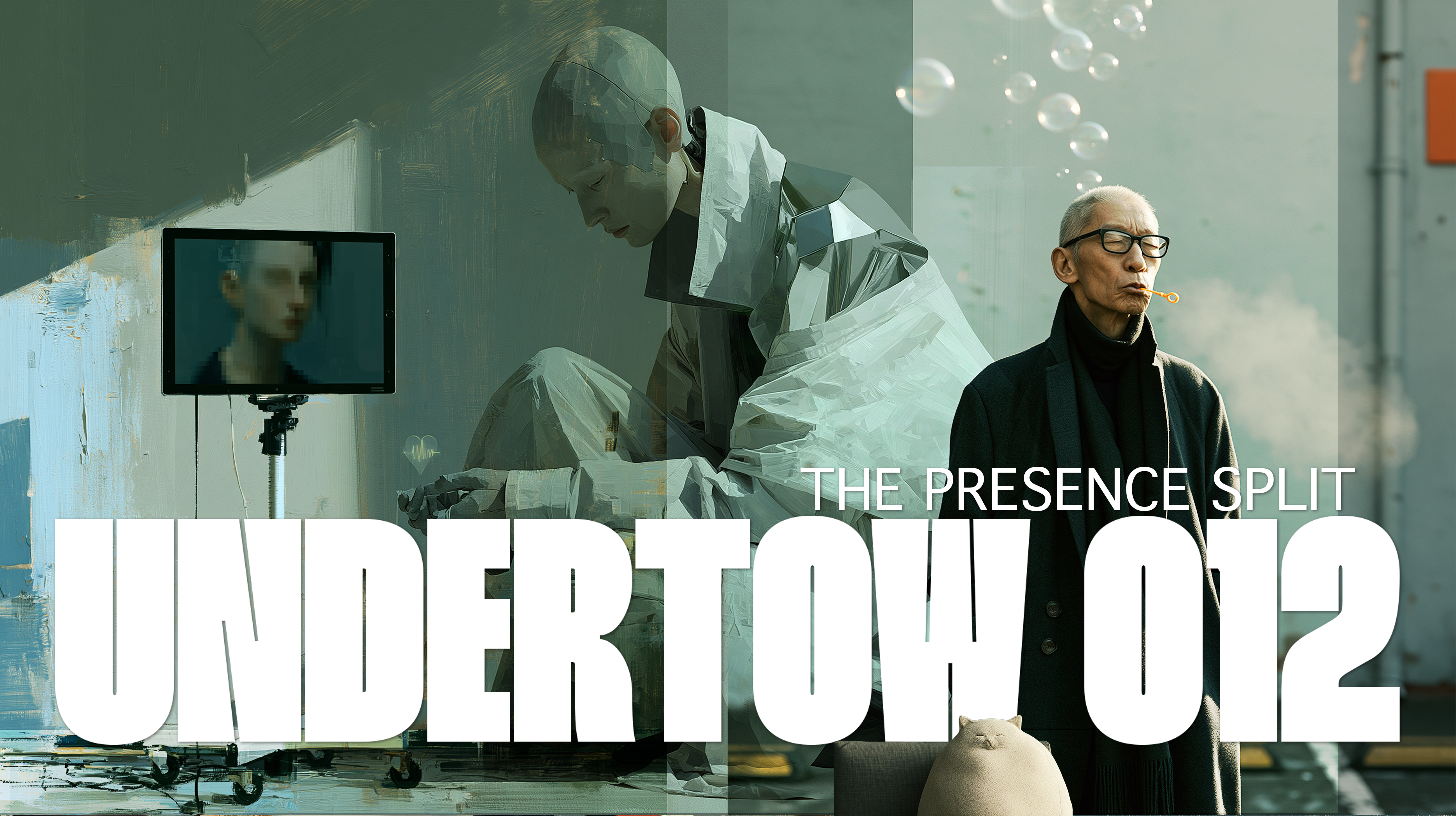
You're reading UNDERTOW. Each essay names a behavior of the AI transition that's already happening but nobody will confess to yet. This one is called the presence split. The term is the product. Take it with you.
A weighted plush cat, made by a company called Chongker and sold for about eighty dollars, contains two mechanisms. One produces a purr. The other produces a heartbeat. The heartbeat is the engineering achievement: a pulse calibrated against what a resting animal’s rhythm does to the nervous system of a person holding it, then tuned until the object, set in a lap, reads to the body as another living thing in the room. It ships to the lonely and the old. Its central virtue is that no one has to be present for it to arrive.
In a hospital, a physician enters the room of a frightened family as a tablet mounted on a wheeled pole. The arrangement is described, by the people who built it, as a way to give the doctor’s time back — to free the hours so they can be reinvested in the part of medicine no machine can do: sitting with the family, the hand on the rail, the chair pulled close. In the same breath, that human visit is named as the premium tier. Available, the way leather seats are available, at the trim level you happen to have paid for. Same comfort. Two prices. The difference between them is a person.
Set the two objects side by side. The same act — to be attended to, to be kept company by something that registers your distress — costs about eighty dollars on one end and, on the other, a figure most people cannot name.
(In a parking lot off a state route, on a weekday afternoon, a man on his break stands holding a plastic wand and blows soap bubbles into the cold — the full choreography of a cigarette break with no cigarette in it. Nobody is selling him anything. We will come back to him.)
The available reading of all this is already everywhere, and it consoles or alarms by temperament: the machines are rising, the human touch is becoming precious, and that is either a comfort or a loss. The reading is not wrong. It is incomplete in a way that happens to flatter the people doing the dividing.
The market is not simply walling presence off behind a price. It is running a more elegant operation. It takes one need — to be in the company of something that attends to you, a need none of us ages out of — and divides it in two. The human half is enclosed and sold to those who can pay. The synthetic half is manufactured at scale and handed, free or nearly free, to everyone else.
Call it the Presence Split. The copy for everyone, the human for the few.
Each half can be defended on its own. Only together do they show their shape.
The half that multiplies
For most of the history of the species, the machine could not enter the room as a body. That is over. In April of 2026 a humanoid finished a half-marathon outside Beijing in fifty minutes and twenty-six seconds — faster than any human has run the distance. Call it a stunt; the skeptics did, and they weren’t wrong: a rehearsed course, handlers trailing to right the ones that fell, only about a third of the field running without a remote. But the same race a year earlier took the winning robot two hours and forty minutes. The part worth watching isn’t the win. It’s the slope — how fast that number fell, and that it hasn’t stopped. By May, Japan Airlines had begun trialing humanoid robots at Haneda for baggage and cabin cleaning, in a two-year experiment with GMO AI & Robotics primarily using Unitree's 132-cm G1 (with UBTech's Walker E also reported in the trial). The companies' rationale, in their joint April 27, 2026 announcement, was that a human-shaped robot 'allows their introduction without significant modifications to existing airport facilities or aircraft structures' — the airport was built for people, so the machine has to be one too. Unitree, the Chinese firm that has shipped more humanoids than anyone, filed to go public near a seven-billion-dollar valuation, its humanoid revenue having just passed its robot-dog revenue for the first time, its entry model now priced under six thousand dollars — the threshold at which a thing stops being a marvel and starts being inventory.
The body, in other words, is no longer the scarce part.
Which tells you something about which body gets built. A machine is made to run a half-marathon because someone will pay to watch it cross the line. A machine is made to wheel into a hospital room because someone has done the math on what the doctor’s hour is worth. Both bodies are arriving. Only one of them is being built to hold you. That is the test under everything here — the cat, the tablet, the app, the airport robot, and soon the people who build them: after the machine arrives, is there more of a person in the room, or less?
Which is why the synthetic half of presence is arriving first and arriving cheap. The companion cat with the tuned heartbeat. A robot dog built for the old, that stays silent unless you ask it to speak, so it will not wake the person it was bought to comfort. Free tiers of companion apps that answer at three in the morning, every morning, without fatigue or resentment. More of us have opened one than will say so.
And the finding that licenses all of it: a study out of Harvard Business School concluding that an AI companion relieved loneliness about as much as another person did. About as much. That is the sentence that lets a budget meeting feel like a mercy.
The half behind the gate
Now the side that is becoming scarce. The same market that promises the lonely a serviceable substitute has quietly inverted its defaults. A growing share of consumers now expect a machine for ordinary service and treat reaching a human as a premium feature. Klarna’s chief executive has said it without embarrassment: human service is always going to be a VIP thing. Concierge medicine sells the doctor’s attention by annual membership. Wealth management assigns a named human being only above a balance. The airline phone tree is engineered, with real care, to wear you down until you accept the bot.
This is the half of the split where contact itself becomes the line item: the Mercy Tier, the human attention you reach only above a balance, at the trim level you happened to pay for.
Same comfort. Two prices. The difference between them is a person.
But price is not the only gate, and not the one most people are behind. You were never going to be in the room. You are a city and an ocean and most of a day away, which is where you usually are, the arrangement your whole life has settled into. The accident sounded like nothing when the first message reached you, the kind of thing a person walks off in a week. It was not nothing, and the week became a long stretch in a hospital you will never see, in a time zone hours ahead of yours, so the updates arrive while you work and the worst of them arrives while you sleep, already true by the time you wake. When presence finally comes, it comes the only way the distance allows: a screen, a connection that drops and returns, a face rendered at the bitrate the moment can spare. The capability crosses the world in an instant. The hand you would have held does not cross at all. When the screen goes dark, the family who made it to the room is left with the pole. You are left with the phone, gone cool in your hand, in a kitchen where it is somehow still afternoon. And the day where you are keeps going, indifferent, and you get up and do the next thing, because the next thing is the muscle you have built instead of grief.
This is the gate that posts no price and admits to no policy, and it is the one almost everyone is behind. A body cannot be in two places. No one has built the thing that lets a human presence scale across an ocean, and no one will, because the whole logic of the age is to send the copy where the person cannot go. What the hospital rations by price, the distance rations for free, and the substitute it hands you is the same rendering, offered with the same generosity, in place of the same missing person.
Who gets the human
Care and attention are not disappearing. They are being rationed and sorted. The only question worth asking is why the sorting runs in the direction it does — why the free thing floods toward the people with the least, and the human thing retreats toward the people with the most. The answer is not cruelty. It is arithmetic.
It is the most efficient subtraction ever devised: the kind the subtracted party says thank you for.
Anyone who has built the model for a care-tech raise knows which line the money is on. A synthetic companion is software: build it once, and every copy after costs almost nothing, in any number of rooms at once. A human companion runs about thirty-five dollars an hour in 2026, in exactly one. One of these scales. The other does not, and a thing that doesn’t scale is, to capital, a thing that can’t be fixed — only afforded. Presence that multiplies has a business model. Presence that’s given has a payroll. Which is why the human ends up wherever the money already is.
So the free copy is not free. It is the only version of company anyone has worked out how to manufacture — which makes it the version that gets manufactured, and handed down, and called enough.
A society can meet pain with comfort instead of with its cause — soothe the suffering rather than ask what produced it. The philosopher Byung-Chul Han calls that the palliative society. A free synthetic companion is palliative care for a structural wound. It soothes the loneliness without touching the thing that made the loneliness cheaper to soothe than to solve. And because it soothes, the wound stops presenting as a wound. It presents as a gift.
That is the part the gift hides. The sorting decides which bodies receive a human and which receive a fluent imitation, and it makes that decision through price and routing, never through a stated rule — because the rule could not survive being said aloud. No one will stand up and announce which patients are worth a person. They don’t have to. The trim level says it for them.
The cup of tea
Here is the strongest objection, and it should be met at full strength rather than managed. The synthetic half is not only comforting the lonely in rich countries. It is reaching people who never had access to anything. At international summits through 2026, India has been held up as the case: specialist-grade TB screening carried to its remotest villages — what one Indian commentator framed, in a Daily Guardian essay, as care delivered 'for the price of a cup of tea.' A community health worker walks in with a portable X-ray unit and a phone; the scan is read on the spot by an algorithm — Qure.ai's qXR (deployed in 105+ countries across 5,000+ sites) and DeepTek's Genki (which has screened over half a million people in Tamil Nadu alone) are the tools that recur in field deployments — and not by a radiologist who was never going to reach the village. Peter Sands, who runs the Global Fund and whose organization has put almost $200 million into AI-enabled TB screening in the past four years, has put it flatly, speaking about refugee camps in Chad: 'There are no radiologists. So who gets to look at the thing and say, is there a problem here or not? Well, actually, AI does. It's brilliant.'
So look closely at what the village case is doing — not in the village, but in the argument.
The villager gets the screening. The villager does not get the radiologist. The capability is redistributed; the human is not. But the honest thing is to say it plainly: in the village, that is not a theft. No radiologist was ever coming — not at this price, not at any price — so the screening is first access, and first access to a tuberculosis diagnosis is a life. The gain is real. The gain is not the trick.
The trick is what the gain is used for. The village is the showcase: the one case where the copy reaches someone who had nothing, carried to the summit, set on the slide, and used to license every case that is nothing like it — the ones where a human was there, was reachable, was affordable, and is now being withdrawn and sold back in the Mercy Tier. The cup of tea is real, and it is also the advertisement. The unimpeachable case is what launders the rest, and that — not the village — is the split working as designed.
The cup of tea is real, and it is also the advertisement.
That is the engine, and it earns a name of its own: Presence Laundering. The copy is not a fake, and that is the whole mechanism. The same realness that screens the farmer and warms the widow’s lap is exactly what lets a company put the human behind a paywall and still look generous for handing you the copy. The remedy and the poison are the same thing. The free gift makes the rationing of the human read as generosity, the way laundered money comes out clean.
Because here is the part that runs on the body, not the balance sheet. You cannot resent a system for taking the human away when it is so visibly, so generously, putting something into your hands. The gift arrives and the grievance can’t form. You were given something — what is there to mourn? It is the most efficient subtraction ever devised: the kind the subtracted party says thank you for.
The generosity is the alibi.
I should be honest about which side of this I have been on. There is an hour, late, when the choice is to call a person who might not answer or to open the thing that always will. I have opened the thing that always answers. It helped, about as much as the study says it does. And the help was real enough that I did not make the call — which is the whole mechanism in one evening, run on a single body. Mine.
The bubbles
Which returns us to the man in the parking lot, and to the thing he is doing that, by the logic of the split, should not exist.
For a century the cigarette was the thing that bought the break — not the nicotine, the break. You stepped outside because you had a reason a clock would accept, and in the cold a few steps from the door you got the pause, the few minutes that belonged to no one, the nod to whoever else was out there. The cigarette was the product wrapped around all of it. You paid for the wrapper; the pause came free inside, and no one noticed it was free, because it arrived attached to something with a price and a tax stamp.
He has dropped the wrapper. No cigarette, just a plastic wand and a jar of soap and a stream of bubbles going up into the cold off a state route on a weekday afternoon. It looks ridiculous, and it is not. He has kept the whole human part — the stepping-outside, the pause, the small absurd thing to do with the hands, the bubbles drifting to the next car where a kid turns to watch them come apart in the air — and thrown out the only part anyone ever found a way to sell. There is no tier. There is no upsell. He is producing presence, in the open, for free, and there is, maddeningly for the market, no way to bill a second of it.
But synthetic presence is not always the counterfeit. A wildlife rehabilitator raises an orphaned hawk behind a puppet shaped like its mother, hiding her own face for weeks on purpose, because a bird that imprints on a person can’t be released — it will die loved, in a cage. The fake parent is the mercy. There are people for whom the companion cat is exactly that: a human visitor would frighten rather than comfort, and the warm weight in the lap is the kindest thing in the room. The line was never synthetic against human. It is whether the synthetic thing was routed to someone whose real need was the human one, then billed as if the need had been met — and that does not show up in the demo.
For anyone building in this — the robotics operators, the care-tech founders, the capital behind them — there is exactly one question that sorts the work, and it is not whether the deployment looks humane in the deck. It is which side of the Presence Split you are building — whether the thing you ship returns a human to the room or stands in for the one who left. Run it on your own roadmap: once your product ships and works, is there more human attention in the room, or less?
Run it on these two. One is a machine that lifts a patient so the nurse who used to spend her back on the lifting can spend the time on the edge of the bed instead. The other is a tablet on a pole that delivers the news so that no nurse has to be in the room at all. On the slide they are the same slide — efficiency, scale, care at lower cost — and they post the same metrics, too: visits handled, cost per encounter, hours saved. The number that separates them is the one nobody charts: minutes of human presence per patient, before and after. In the room they are opposites. One hands a person back. The other takes the last one away and leaves the pole.
You can also read it off the pricing, even when you can’t read it off the demo: if your roadmap routes the synthetic version to everyone by default and reserves the human for the customers who pay more, you are not lowering the cost of care. You are building the paywall, and the free tier is your alibi. That is a choice a product team makes on purpose, in a planning meeting. It can be unmade in the same one.
The market will never make you tell them apart. The person in the room always will.
There are two free things in this essay. One was built in a laboratory to hold a heartbeat against a chest until the chest stops noticing it is not a person. The other is a man in a parking lot blowing soap bubbles into the cold for no reason any company has yet found a way to invoice. At a glance they look like the same gesture: comfort, offered, at no charge. They are exact opposites. The entire Presence Split runs on getting you to take the first and forget the second was ever there.
Free is what they hand you. Given is what they can’t.
What To Brief From This
If you’re an agency strategist with a brief for anything that ships as a “companion,” “assistant,” or “concierge,” the question is not whether the product comforts. It’s which side of the Presence Split it sits on: does it return a human to the room, or stand in for the one who left? Write the brief that can answer that out loud, because the audience will eventually ask it for you.
If you’re a brand-side CMO or head of innovation whose roadmap routes a synthetic experience to everyone and reserves human contact for the top tier, you are building a paywall and calling it access. Name it honestly inside the building before someone outside it does. The free tier is not generosity. It is the alibi, and alibis expire.
If you’re a VP of Product at a robotics or care-tech company, put the one metric on your dashboard that nobody charts: minutes of human presence per user, before and after you ship. Visits handled and cost-per-encounter read identically for the machine that hands a person back and the machine that takes the last one away. Only that number tells them apart.
If you’re raising or deploying capital here, the humane framing in the deck is not the diligence question. The diligence question is whether the model only closes by replacing a human who was reachable and affordable. That is Presence Laundering, and it is the part that doesn’t survive being said in the meeting.
Forward this to the product lead who keeps calling the free tier “access” — they can still unmake the paywall in the same meeting where it got drawn.
The specifics, for the record:
The heartbeat cat is Chongker’s companion cat.
The humanoid that beat the human half-marathon world record (fifty minutes, twenty-six seconds) was Honor’s “Lightning,” at the Beijing E-Town Half-Marathon, April 19, 2026.
The maker going public near seven billion dollars, its humanoid sales just past its robot-dog sales, is Unitree, on Shanghai’s STAR Market.
The airline trialing humanoids for cleaning and baggage is Japan Airlines, at Haneda.
The robot dog is Tombot’s “Jennie.”
The fintech chief executive is Klarna’s Sebastian Siemiatkowski.
The loneliness finding is De Freitas, Oğuz-Uğuralp, Uğuralp & Puntoni, “AI Companions Reduce Loneliness”(Harvard Business School / Journal of Consumer Research, 2025).
The India tuberculosis screening runs on tools like Qure.ai's qXR and DeepTek's Genki; the Global Fund figure and 'brilliant' quote are Peter Sands's (NPR's Goats and Soda, Nov 2025); the 'price of a cup of tea' framing is from a Daily Guardian op-ed by Siddhartha Bhimireddy (May 19, 2026), not from Sands or a summit.
“The palliative society” is Byung-Chul Han’s.