

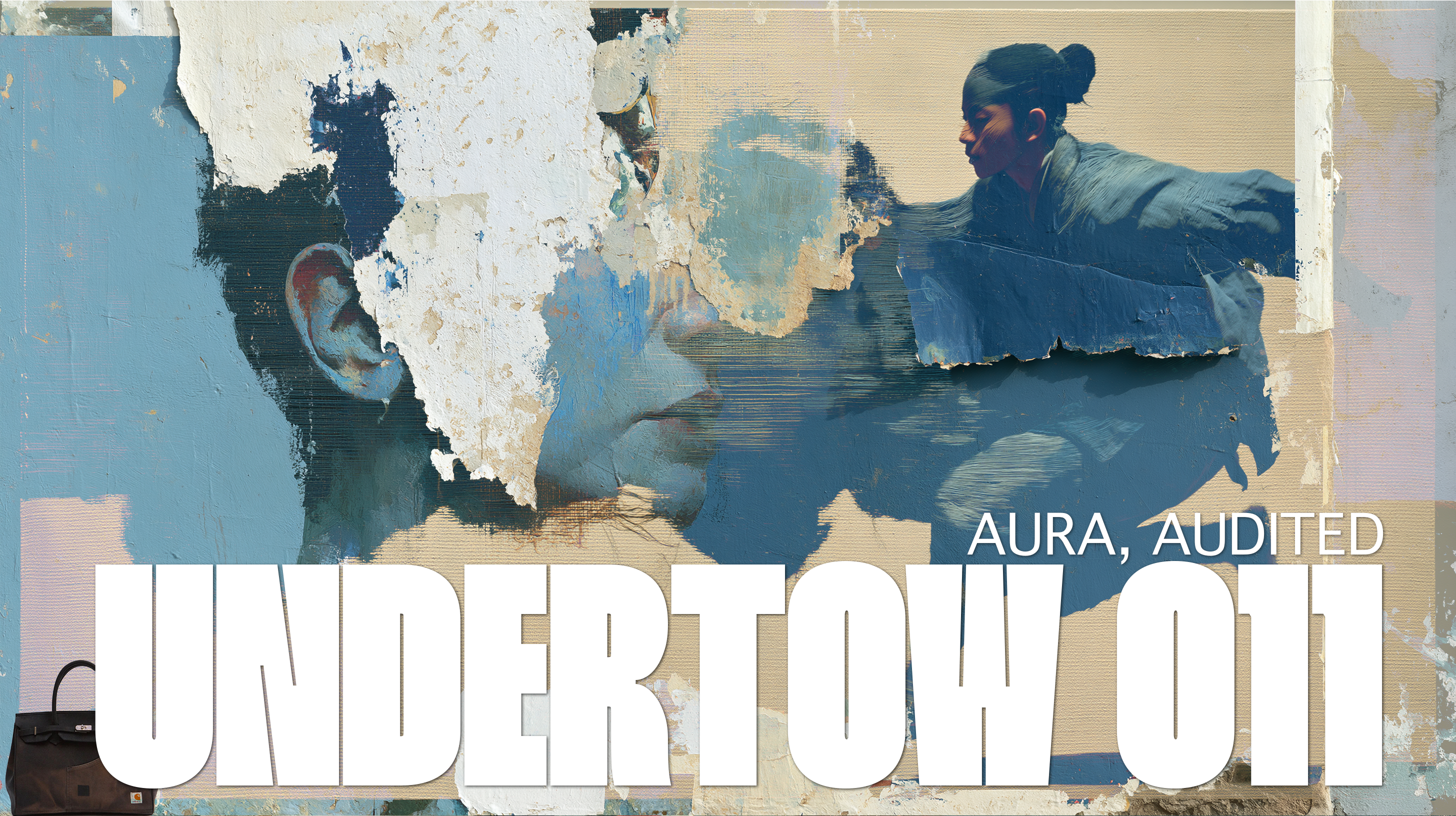
UNDERTOW is an ongoing analysis of cultural production at the structural level — naming the conditions that produce the moves, not just the moves themselves. The concepts travel when readers use them in rooms I'll never enter. Each piece is honest to what I'm seeing right now.
Prada’s conversion data shows that younger clients buy more bag when you tell them exactly how the bag was made: where the leather came from, how many single-artisan hours, which atelier, which technique. For most of the 1900s, luxury brands believed the way to charge $4,000 for a bag was to keep production hidden. Don’t tell the buyer where the leather came from. Don’t show them the factory. Don’t explain the hours. The mystery itself was the price tag. If you tell buyers too much, the bag stops being magical and starts being a product.
Products get price-shopped. Magic doesn’t.
This is the logic that produced the Birkin waiting list, the heritage film that shows everything except labor, the hidden atelier as marketing device, and most of the advertising industry generally — which is built on creating want without showing supply. As of next year, Prada will not have a choice. The European Union’s Digital Product Passport mandate (a chip or QR code embedded in every luxury item that you can scan with your phone to pull up where every component came from, who made it, and how) becomes legally required across the category. Brussels did not pass that legislation because younger consumers asked nicely.
I have been emailing a workshop in Italy this week. They take inherited fabric (like a well-worn and greasy Carhartt coat) and turn it into something that holds the memory of the person who wore it. I have not yet decided which garment to send. I am writing this essay in part to figure out why the question feels heavier than it should.
The Substrate Layer We’re Already Paying For
The Prada finding is not an aberration. The handmade economy is on a trajectory from $906 billion in 2025 to $1.94 trillion by 2033, compounding at 8.83% through the decade. Hermès still requires a single artisan to spend forty-eight hours building one Birkin. Bottega Veneta’s intrecciato weave still requires a hand. Visvim hand-looms denim on antique Toyoda shuttles in Okayama and charges what Loro Piana charges because Hiroki Nakamura was right: the substrate is the brand. The trillion-dollar growth is not coming from the heritage houses. It is coming from a $54 billion arts-and-crafts segment compounding at 4.5% and from Etsy’s fastest-growing category, DIY kits. Handmade has stopped being a category and started becoming a quality standard. The practice of making is becoming a status marker on par with owning. (You cannot delegate having a creative practice. Which is the point.)
The luxury read of all this is that younger consumers care about sustainability. The harder read is that something is producing demand for human substrate work at a scale and pace that the conventional craft revival framing cannot explain.
What AI’s Economy Actually Created Demand For
Neon Oni, the AI-generated Japanese metal band I wrote about earlier this year, was outed in October 2025 when fans noticed AI artifacts in the music videos. The band’s creator KAGE recruited seven real musicians from Tokyo bands to play the songs live. They toured Japan through the spring and made the finals of Wacken Metal Battle Japan 2026, just missing the slot to represent Japan at Wacken Open Air in Germany. The image, the styling, the songs in some cases. All generated. The audience paid to be near actual bodies playing actual instruments. The most algorithmic thing in the room paid for the least algorithmic thing in the room because nothing the model could output would substitute for what only bodies in time can produce.
Before April, an entire ecosystem sat between the AI model and the actual deliverable: prompt engineers, AI workflow consultants, agencies stringing together model outputs with human-in-the-loop checks. Then Anthropic shipped Claude Design and OpenAI shipped sandboxed Codex agents in the same month — both products absorbing that middle layer of work directly. By May 4, the labs were going at the consulting industry itself. Anthropic launched its enterprise services venture with Blackstone, Hellman & Friedman, and Goldman Sachs. OpenAI is raising $4 billion for a parallel one called The Development Company. Both adopt Palantir’s forward-deployed engineer model: embed engineers in portfolio companies to redesign workflows from the model up. The consulting margin McKinsey and BCG priced their existence on is now contestable by the model providers themselves. What they cannot absorb is the human in the room when something is actually being made. The casting director in the room when the actor walks in. The colorist on the final grade. The hand on the leather, the eye on the seam.
The Substrate Doesn’t Stay in the Atelier
In second-tier Chinese cities, dead malls are being repurposed by youth into AR battle royale arenas. Laser-tag-style PUBG-IRL competitions in which storefronts and Mixue ice-cream counters and Wallace fried-chicken windows function as cover. Two decades of overbuilt commercial real estate, hollowed out by youth unemployment and a consumption shift away from conspicuous spend, are being claimed by the kids before institutions notice.
In Chinese cities generally, the fastest-growing cultural practice among twenty-five-year-olds is birdwatching. Yes, literal birds. Binoculars, an ID app, a park bench, the patience to sit and wait. Xiaohongshu birding posts in the past year exceeded 1.2x the prior decade combined. Over a billion views. The behavior is small and replicable: find a corner of the city, visit it often, learn what is already there. Trend pieces will frame this as wellness or nature connection. The structural read is that birding is post-tangping attention discipline. Tangping (”lying flat,” the 2021 youth movement of refusing the work-marriage-mortgage script) was the disengagement. Birding is the engagement that comes after. Choosing what to look at rather than being shown what to look at, voluntarily, repeatedly, as practice.
Both are the substrate showing up before the institutions notice. Body in space, attention on what’s there. The kids are early.
What Mechanical Reproduction Took, Legislation Now Restores
Walter Benjamin wrote in the 1930s that mechanical reproduction strips aura: the unique presence in time and space that made an artwork feel like the thing itself rather than a copy of it. The twentieth-century luxury industry adapted by manufacturing aura through marketing scarcity, origin storytelling, and theatrical opacity. The Birkin waiting list. The heritage film. The hidden atelier as marketing device. By the 2020s, the same trick had migrated to the personal: aura as Gen Z social currency, farmed on TikTok and traded in ‘aura points,’ performed without substance underneath. None of this required actual provenance to survive consumer scrutiny. It required only the appearance of provenance, narrated well.
By 2026, the same dynamic surfaced on the production side. Emily Segal named it tasteslop: the visible signs of taste extracted from their social relations and redeployed generically. AI moodboards stocked with Rimowa and Dieter Rams. The Notion office. The influencer dinner thrown by a frontier lab at a classy restaurant. Taste markers detached from the bodies and histories that gave them meaning, recombined at zero cost. Aura points were the symptom in the consumer. Tasteslop is the symptom in the supply.
AI accelerates the reproduction crisis to total carpet-bomb saturation. Image, voice, text, video, music, code — every medium of representation collapses into infinite output at zero marginal cost. A Veo 3 short in Wong Kar-wai’s shot grammar, generated from a paragraph of prompt. A Bourdain voice clone narrating copy he would never have read, free, in a browser, from thirty seconds of source audio. A Vogue Italia spread generated overnight, indistinguishable to anyone but Steven Meisel. Any genre, any voice, any rhythm, on infinite supply. Faster than the originals can be performed. Indistinguishable from the originals to anyone scrolling. Aura cannot be culturally maintained at this rate.
The European Union’s Digital Product Passport mandate is aura, reconstructed in law. Provenance becomes legally required disclosure. The unique presence in time and space is now documented through state-mandated audit trail rather than through marketing artifice. What mechanical reproduction took, legislation now restores. The state is doing what the culture can no longer do alone.
What mechanical reproduction took, legislation now restores.
(I am not sure Benjamin would be pleased. I think he would be alarmed and unsurprised. The aura he watched leave was the aura of art’s relationship to ritual. The aura we are watching return is its relationship to law. The first was witnessed. The second is enforced.)
Bourdieu watched the same dynamic from a different angle. He spent his career mapping the long war inside the dominant class: economic capital, the side that owns, versus cultural capital, the side that knows. Twentieth-century luxury was economic capital trying to buy what only cultural capital could mint. The manufactured aura, the storied atelier, the heritage film: these were the rich purchasing taste they had not earned. AI’s reproduction crisis exposes what was always true. When every sign can be cloned in thirty seconds for free, the markers of taste come unstuck from the work that gave them meaning. The money no longer buys the meaning. The Digital Product Passport is Brussels putting the audit on the cultural-capital side of the line. Cultural capital was losing. The state put a floor under it.
The body is the original audit.
There is a kind of body knowledge you only get from wearing and walking in the same designer’s clothing every day for years, especially in New York, where there is no car, no valet, no garage between you and the day. The body is the vehicle. Stairs. Subway crush. Weather. An ACRONYM messenger bag heavy with the day’s load. Sweat through summer. Brace through winter.
The ACRONYM jacket I wear has interior pockets that don’t spill. What Errolson Hugh calls “first person” design, the pocket placed for the body wearing it, not the patternmaker drawing it. Errolson has been after this since he was ten and discovered the karate gi let him kick when his school pants would not. The Rick Owens jackets I travel with, almost as often as the ACRONYM ones, have interior pockets sized for what Rick called, in 2009, a book and a sandwich and a passport. Mine carry an iPhone, AirPods, and the anti-gas capsules that help me endure long flights. The principle is the same. The pocket is shaped for the wearer’s day, not the runway’s. Sacai’s seams make sense only in motion. CdG is forty years of Rei Kawakubo’s pattern grammar in a single garment.
These clothes are not luxury items in the legacy sense. No logo. No shouting. Nothing legible outside the language. Luxury because cost-per-wear, after a decade or more on some of these pieces, is closer to a Uniqlo basic than to anything in the legacy luxury column. They are bodies of work my body has verified every day for years. The receipt for what made them is not a marketing claim. It is what the body knows after the reach, the bend, the train, the rain, the long Thursday — and the jacket still holding. (There are days when this feels precious. There are also days when it does not. There are days when I am tired, and the clothes are still doing what they were made to do, and that is when I notice them most.)
The substrate isn’t the layer being protected. It is the layer that determines what can grow above it. The body in motion shaped the ACRONYM pattern. The wearer’s day shaped the Rick Owens pocket. The hand at the bench shapes the Italian bag.
This is the context in which I have been emailing the workshop. They will take inherited fabric, something with a body’s prior life already inside it, and Italian artisans I have not yet met will turn it into a hand-built tote: rolled handles, turn-lock clasp. It will be used daily without fear. Get dirty. Scuffed. Scratched. It will age the way the body does. Into more of itself, not less.
It will age the way the body does. Into more of itself, not less.
The provenance is baked into the material. The audit is baked into the construction.
The thing will exist nowhere else and will not be reproducible. This is not a fashion purchase. It is an active enrollment in the substrate-and-audit economy that the EU just legislated a floor underneath.
The Prada conversion data and the Neon Oni musicians and the twenty-five-year-olds with binoculars in city corners are not three different stories. They are the same story being told in three different industries at the same time. The frontier labs created a market for what the labs cannot make. Brussels just made the receipt the law. The cultural counter-formations are doing the rest unfunded — youth in Chinese dead malls, design collectives in Anhui villages, the writer’s own wardrobe of clothes whose Italian factories have addresses you could drive to. The substrate layer is not a niche or a nostalgia. It is the new premium infrastructure being constructed in real time, in regulation, in commerce, and in attention. The Audit Premium is the price floor underneath it.
The names already exist. Substrate Layer. Audit Premium. We are going to need a third one for what the regulation is actually doing: making the floor under the substrate economy mandatory rather than market-driven. Call it the Reconstruction Floor. When the culture stops minting aura, the state mints it. Aura, audited. Aura, restored. Not by the culture. By Brussels.
The Audit You Did Not Know You Were Already Failing
An audit asks three questions an agency does not yet have to answer. What was generated and what was made. Whether the named creative actually did the work the case study credits them for. Whether the production happened where the deck said it happened. Work that can answer all three is audit-bearing. Most agency-produced creative work has never had to be.
That gap is the new premium.
Most premium positioning was built on packaging that the EU has just made legally permeable. The agencies whose actual production survives audit will eat the agencies whose premium was always storytelling. The brand-side leaders who do not yet know which of their suppliers is which are about to find out.
If your work is not audit-bearing, the next three years are going to compress your margins, your headcount, and your relevance.
Economic capital can no longer buy what cultural capital used to mint.
The frontier labs will eat the surface work. The regulation will eat the unaudited premium.
The labs will eat the surface work. The regulation will eat the unaudited premium.
What survives is what can prove what it is.
The forward path is not defensive. The agencies and brands that move first will define what audit-bearing creative work looks like as a category. The product teams that ship provenance attestation before their enterprise customers require it will define what audit-bearing AI looks like in theirs. Both groups are defining the standard before it gets defined for them. The ones that wait will be defined by it.
What’s Coming, and When
Within twelve months, by May 2027, the first WPP/Omnicom/Publicis-tier holding company will lose a brand client over undisclosed AI in production.
Within twenty-four months, by May 2028, one of them publishes provenance data on a campaign as audit-defense.
Within thirty months, by November 2028, EU-equivalent provenance disclosure legislation will reach at least three US states, with California first. The Reconstruction Floor goes from European to global within the same window.
Within thirty-six months, by May 2029, the major creative-tooling AI companies (Runway, ElevenLabs, Suno) will have built provenance attestation directly into their product, because their enterprise customers will require it.
Within sixty months, the dominant premium category in luxury will not be “made by a master craftsman for you” but “made by you under master craftsman supervision.” The brand will become the curriculum.
The most valuable thing in 2030 will be the receipt for what your hands actually did.
Track these. I will.
The bag I have not yet decided about is in my email as a query of size dimensions and material questions. Italian artisans in a workshop I have never visited will make it from a piece of fabric I will choose because someone wore it before me. It will exist nowhere else.
What survives is what can prove what it is.