

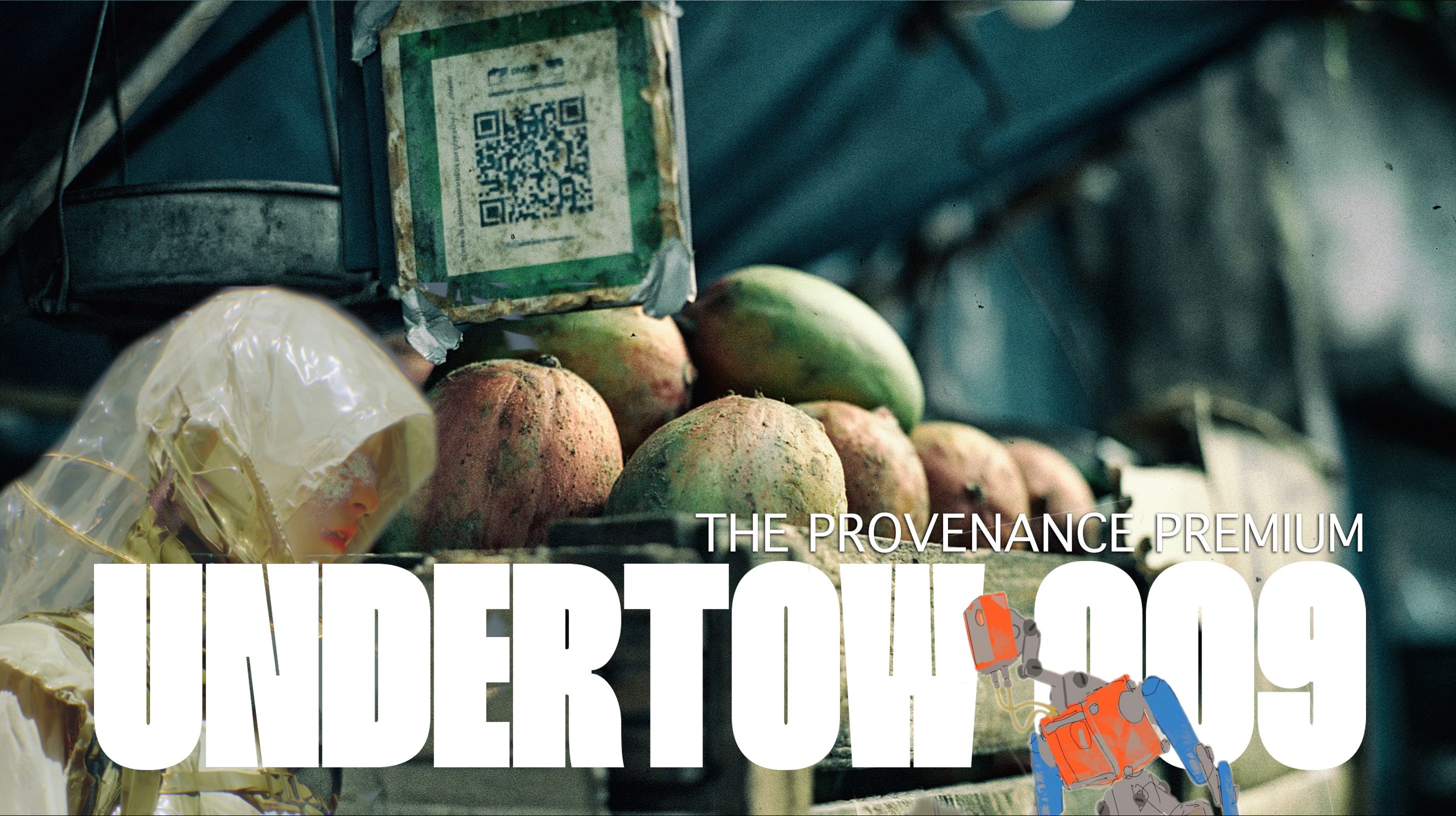
UNDERTOW is an infinite report. A limitless USB stick for cultural intelligence. A living container that doesn’t finish, only accumulates, and keeps... growing. The concepts travel when readers use them in rooms I’ll never enter. The only requirement is that each piece is honest to what I’m seeing right now.
On a Sunday morning at the feira on Rua Cardoso de Almeida in São Paulo, a woman sells mangoes from a wooden crate. The price is written on cardboard in black marker. A QR code sticker, faded green at the edges, is taped to the side of the scale. A customer holds up his phone. The vendor taps her screen. There is a chime, two quick notes. Most Brazilians recognize the sound. The money is in her account before he picks up his bag. Thirty-eight reais. It is Sunday, before noon, and the transaction has cleared.
She does not have a card reader. She does not have a merchant account. She does not pay interchange. She has a QR code taped to a crate and an app she downloaded free, and the money that just arrived in her account moved through rails operated by the Central Bank of Brazil. This happens two hundred million times a day in Brazil. Six billion times a month. The vendor is not thinking about it. Her customer is not thinking about it. They are buying mangoes.
There is a sticker like hers on most vendors in most feiras in most Brazilian cities. It has been there, in some form, for five years. Nobody writes about it anymore.
Seven time zones east, on the evening of February 27, 2026, Gucci staged its Primavera campaign around Demna’s debut for the house at Milan Fashion Week. The campaign was released online the same week and carried a small disclosure at the corner of each image: Created with AI.
Within forty-eight hours Gucci was in crisis. Instagram and X produced the backlash at a volume disproportionate to the collection. The conversation was not that the imagery was ugly. The imagery, in fact, was fine. The conversation was that a Gucci bag starts at eight hundred and fifty dollars and runs to ten thousand, and the price is a story about where the money went. Someone designed it. Someone sourced the leather. Someone cut the pattern. Someone stitched it. But the ad for the bag had just admitted that nobody did any of that work for the ad. If the ad was made by AI, the bag might be too. Customers were asking the question out loud on Instagram. Gucci had paid Demna. Demna had paid an agency. The agency had paid for AI image generation. And the cost of AI image generation, compared to the cost of flying a photographer to a location, hiring models, renting a set, and shooting for three days, is roughly... nothing. The markup on a four-thousand-dollar handbag used to pay for human hands. It was now paying for somebody’s cloud computing bill.
The objection was accounting, not aesthetics. If the ad was cheap to produce, the product was fraud at the price point.
All of this arrived at a bad moment for Gucci. The house had posted a 22% revenue drop in 2025 inside its parent company, Kering. Demna had been hired to turn that around, and the Primavera campaign was the first major thing anyone had seen from him. Putting an “AI” label on that campaign, in that week, turned out to be exactly the wrong call.
Across the rest of luxury, the opposite play was already in motion the same week. Bottega Veneta was running “Craft Is Our Language,” a campaign built around named artisans and fifty years of its Intrecciato weave. Loewe was posting intimate workshop content about hands on leather. Louis Vuitton had quietly doubled down on its atelier programming across watchmaking, leather, and jewelry. The rest of the market had read the same room Gucci had, and was buying provenance as a hedge against the same collapse.
A French philosopher named Jean Baudrillard spent his career on a version of this problem: what happens to the idea of “the real thing” when copies get good enough that you cannot tell them apart from the original. His answer, roughly, was that whatever could still prove it was real became the new premium. That is what is happening now, in 2026, but with one new wrinkle: the proof is becoming something you can verify with software. The handmade bag is expensive because it is not AI-generated. What you are paying for is no longer the craft. It is the proof of the craft.
Call the pattern the Provenance Premium. The price of anything whose production can now be cheaply faked is increasingly a price on the verifiable proof that it wasn’t.
None of this is unprecedented. Every commercial civilization before the industrial era tied value to attested origin — the guild mark, the merchant seal, the provenance chain. Mass production with anonymous labor, bought on trust in brand alone, was the exception. We are not inventing the proof economy. We are remembering it, with new tools.
Right now, at least six different companies are trying to become the official “human-made” certifier — names like Humanmade.art, HUMA Certificate, Done By Humans. HUMA has even proposed a four-tier rating system ranging from “Pure Human” to “AI-Curated.” None of them has won yet. If this sounds familiar, it should. The landscape right now looks a lot like the organic-food labeling market did in the mid-1990s: a handful of competing private certifiers, no dominant standard, everyone waiting for the equivalent of the USDA organic seal to show up and settle it.
The technical infrastructure for that settlement is already being built. A standard called C2PA lets you embed a tamper-resistant provenance record directly inside an image file, so anyone looking at the image can see where it came from and what edited it. Adobe’s Firefly embeds C2PA from the moment a file is created. OpenAI’s DALL-E 3 embeds it. Midjourney, so far, does not. In 2024, Getty Images published research showing that 90% of consumers worldwide want to know whether an image was created using AI, and 98% said authentic images and videos are pivotal to trust. The provenance infrastructure is arriving because the consumer demand for it is already here.
The luxury market has a name for what it is doing. It is not rejecting AI. It is rebuilding its class hierarchy around provenance, because the production mystique that carried the postwar luxury economy collapsed the moment the mystique became trivially cheap to produce.
Conagra added “GLP-1 Friendly” to the front of Healthy Choice boxes. Not a health claim. Not a calorie count. Not the Good Housekeeping Seal of your grandmother’s cupboard. A sticker announcing that this frozen dinner is compatible with a pharmaceutical your doctor prescribed — whether or not you needed to lose weight in the first place. The label is not about what the food is. It is about which body is going to eat it. That is a signal that the category has moved.
A line heard at pharmacy industry conferences in early 2026: “Nobody buys weight loss shakes anymore. Everyone’s on Ozempic.” It sounds like a joke and reads like an inventory report. The weight loss industry, as it existed in 2020, had been dismantled at the shelf level by a drug class that did in eighteen months what SlimFast could not do in forty years.
Around the same time, Novo Nordisk, the Danish company that invented Ozempic and Wegovy, fired 9,000 people — 11% of its global workforce. This was not because the drug stopped working. Eli Lilly, Novo’s American competitor, had launched a more effective weight loss drug called Zepbound and was winning the market Novo had created. Novo lost more than $150 billion in market value. The previous CEO was forced out. The new CEO, Mike Doustdar, publicly acknowledged what the market was doing to his industry: “Our markets are evolving, particularly in obesity, as it has become more competitive and consumer-driven. Our company must evolve as well.” The company that invented the blockbuster obesity drug has been reorganized by the cultural forces the drug set in motion. This is what it looks like when a pharmaceutical company discovers that the drug is in charge of the company, not the other way around.
Then the aftermarket opened. “Ozempic Face” entered the dermatology literature in 2025. A Journal of Clinical Medicine paper out of Northwell Health named the pattern: rapid GLP-1 weight loss produces facial volume loss that reads as distinctively gaunt. The look is specific enough that dermatologists named it before TikTok did — the cheeks collapse inward first, the temples hollow out, then the whole face starts reading like it has lost twenty pounds the body did not need to lose. The aesthetic remediation for this — filler, skin tightening, the adjacent procedures nobody calls procedures — runs the total annual cost of being on the drug past $5,000 before you have accounted for the prescription itself. The drug is covered by insurance when the patient is diabetic and mostly not when they are not. The remediation is covered by insurance essentially never.
The face tells you what the insurance didn't cover.
The face tells you what the insurance didn’t cover.
This is the class tax. If you can afford the drug and the remediation, you can have the body without looking like you bought it. If you can afford the drug and not the remediation, you have the body and look like you bought it. If you cannot afford either, you continue to occupy the body you had before the category shifted. The hierarchy is visible on every face.
The opposite move is already forming. A small but visible tier of drug-free physiques commands a premium specifically because it can be proven. Blood panels are being screenshotted. Training logs are being posted. Whoop, Oura, and continuous glucose monitors are the receipts. The physique is no longer the status signal. The provenance of the physique is.
A birthday dinner in the East Village. I knew one person at the table. The rest were strangers. I was passing the bread basket when a guy I had just met unlocked his phone and with an earnestness bordering on rapture, tilted the screen toward me. A DEXA scan he had run that morning. Nine point one percent body fat. He credited a meat-heavy rotation and two years off caffeine. Across the table, a guest whose face had clearly gone hollow only over the last six months changed the subject. By dessert everyone but me had shown something — a scan, a macro log, a sleep score — and no one seemed to notice they were all doing the same thing. Nobody was calling it that.
The aesthetic object, a body, is valuable now less for what it looks like and more for the auditable record of how it got there. A drug-free 4% body fat with a published protein intake log and two years of sleep data is a different product from a 4% body fat with a GLP-1 prescription and a filler appointment, even if the two bodies look the same in a photograph. The market has begun to treat them as different products because they are differently documented. Your phone has been counting your steps all day. Nobody asked it to.
This is the same move the luxury market made. The hand-stitched bag and the drug-free body are now priced the same way: by the proof of how they got there.
Go back to the feira on Rua Cardoso de Almeida. The vendor. The crate. The faded QR sticker. The transaction that cleared before the customer picked up his bag. We left that scene before naming what we were looking at. The consumer-market version of this pattern — handmade bags, drug-free bodies, C2PA-verified images — is still arguing with itself about whether it matters. At state scale, the argument is over.
PIX is a payment system run by the Central Bank of Brazil. It is free. It is instant. It works every hour of every day. A vendor pays nothing to accept it. A customer pays nothing to use it. There is no middleman taking a cut, because the middleman is the state, and the state decided not to charge. 178 million Brazilians have registered for it, which is roughly 91% of the adult population. It moves 6 billion transactions a month, total flow around $557 billion — larger than every Brazilian credit and debit card combined, by about 80%. The system was built for approximately $4 million in initial capital cost. It generated an estimated $5.7 billion in savings in 2021 alone.
The United States does not have anything like this. FedNow, the closest public equivalent, launched in July 2023 and has reached roughly 1,400 banks out of more than 10,000 as of mid-2025. Zelle is closed — you can only use it between banks that opted in. Venmo and Cash App are private. None of them are public rails. None of them are free to the merchant. The vendor on Rua Cardoso de Almeida has something at a cost and scale the United States has not built for its own citizens.
In July 2025, the United States Trade Representative opened a Section 301 investigation with PIX on the target list. The stated reason: PIX is an unfair trade barrier to American payment companies. The unstated reason: Brazil built something for its citizens that the United States has not built for its own. Lula ran an ad campaign in response — O Pix é do Brasil— framing USTR as a proxy for the American credit card lobby. Colombia’s Gustavo Petro asked Brazil to extend PIX to Colombia and publicly attacked the U.S. Treasury’s OFAC sanctions list as “an aberrant system of political control.”
This is not payment infrastructure. This is what a state can see about the economy it governs. Brazil built it, operates it, and gave it to its citizens for free. In 2026, multiple other countries want what Brazil has. The United States does not have it and is asking, in trade court, that Brazil not have it either.
Brazil built it for commerce. Ukraine built it for survival. Ukraine has a state-built phone app called Diia. Most Ukrainian adults have it. It holds your tax records, your driver’s license, your military ID, your voter registration. During wartime, it also does something else, and this is the part that should stop you. A companion app called ePPO piggybacks on Diia to let ordinary citizens report incoming Russian drones. You see something in the sky, you open the app, point your phone at it, and tap a button. The data reaches air defense officers in two to seven seconds, with AI predicting the target’s trajectory in parallel. This is not a pilot program. It is the actual infrastructure defending Ukrainian cities.
That is the defensive half. Operation Spider Web is the offensive. In June 2025, Ukrainian security services ran an operation that had been eighteen months in planning. More than a hundred small drones were hidden inside civilian trucks and smuggled to positions near five Russian airbases, some as far as Siberia. At a coordinated moment, the truck roofs opened and the drones launched. The AI guiding them had been trained on Soviet-era bombers sitting in a museum in Poltava, not on classified files. The drones used commercial 4G cellular networks and open-source autopilot software. The operation destroyed dozens of Russia’s strategic bombers — aircraft that no longer exist on any production line anywhere in the world. The United States has no equivalent.
The gap between a country that has fused civilian digital infrastructure with its military and a country that has not is widening every month. A Ukrainian engineer named Yaroslav Azhnyuk put it flatly in 2025: “Europe and the United States have progressed, in the best-case scenario, from the winter-of-2022 technology to the summer-of-2022 technology. The gap is getting wider.”
Estonia is further along than anyone else. As of December 2024, every single government service is digital. Voting, taxes, divorce, healthcare, education, starting a business. The whole stack runs on something called X-Road, a data exchange layer that connects every state agency and is used by more than 99% of the country’s residents. Estonia estimates the system saves 2% of the country’s GDP every year — money that would otherwise get lost to time spent on paperwork. The state also runs its own AI assistant, called Bürokratt, which answers citizen queries across agencies in natural language. And in 2023, Estonia’s own e-Governance Academy published a report warning about opaque algorithmic decision-making inside its employment and tax systems. The acknowledgment is the point. A state mature enough to have built world-class digital infrastructure is also mature enough to publish its own critics.
The Gulf is playing the same game at a different scale. Saudi Arabia, the UAE, and Qatar have committed roughly $2.5 trillion in US technology investments across 2024 and 2025 — roughly equivalent to the annual GDP of France. A single campus in Abu Dhabi anchored by Stargate UAE is sized at five gigawatts and comes online in phases starting 2026. None of this is principally commercial. The Gulf is not buying AI. It is buying a seat at the table where AI-era infrastructure decisions get made, and paying the annual output of a G7 country for it.
The United States is running the opposite play. The rails are private. The data centers are commercial real estate. No political consensus says public infrastructure should exist in these categories. The US has the best private infrastructure in the world and almost no public infrastructure in the places where public infrastructure has become the premium. Every time an American small business runs a credit card, Visa takes two percent. Every time an American files taxes, Intuit takes a fee. Every routine transaction that would be free at the merchant edge in São Paulo carries a private toll in Cleveland. The cost has been invisible to most Americans because they have always paid it and have nothing to compare it to. That is about to change.
At consumer scale, the pattern is still arguing with itself. At state scale, it is already compounding. Estonia exports X-Road to other governments. Brazil is rewriting the rules of international payments. Ukraine’s defense stack is being studied inside NATO. Every late country will spend the next decade renting what the early countries own.
Every late country will spend the next decade renting what the early countries own.
Brazil did this with payments. Ukraine did it with defense. Anthropic is doing it with AI.
Anthropic — the company that makes Claude — built a technical standard called the Model Context Protocol, or MCP. The job of MCP is simple and important: it lets an AI system safely connect to outside tools, files, and databases in a standardized way. Before MCP, every company was building its own custom connectors. MCP is the universal adapter. By late 2025, developers were downloading the MCP software kit 97 million times a month.
In December 2025, Anthropic did something unusual: it gave MCP away, donating it to the Linux Foundation, inside a new vehicle called the Agentic AI Foundation. The foundation now has 146 member organizations, including JPMorgan Chase, American Express, Autodesk, Red Hat, and Huawei.
In February 2026, Anthropic’s Series G funding round closed at a $380 billion valuation. By early April, annual run-rate revenue had reached $30 billion, up from $9 billion just four months earlier. Claude Code, the programming assistant, generates $2.5 billion of that on its own. More than 70% of enterprises purchasing new AI tools in 2026 designated Anthropic as their primary target. The IPO is planned for October 2026.
The market explanation for all of this is that Anthropic’s product is better. The structural explanation is that Anthropic’s product is more auditable. MCP was built specifically to let an enterprise — especially a regulated enterprise — inspect every action an AI agent takes. A compliance officer at JPMorgan can look at what a Claude agent did, when it did it, and why. A regulated firm in Europe can produce the exact audit trail the EU AI Act requires them to produce.
What the enterprise is buying is not the intelligence alone. It is the intelligence plus the receipt.
Anthropic giving away MCP to the Linux Foundation is the private-sector version of what Brazil did with PIX. Make the standard free. Make the standard public. Make it the default everyone else has to plug into. Write the version everyone else copies. Build the tools everyone else uses.
The donation does not weaken Anthropic. It strengthens it, because the company most fluent in the standard is the company that wrote it and gave it away. The rails are public. The profits on top are private. The shape of the standard stays with the firm that wrote it. Call it the Donation Moat — the private-sector version of the civic move Brazil, Ukraine, and Estonia have been making at scale.
Enterprise buyers in 2026 are no longer choosing AI models on intelligence. They are choosing on what can be proven. In the same way a Gucci bag now has to come with proof of its stitching, and a drug-free body now has to come with proof of its protein log, an enterprise AI tool now has to come with proof of what it did. The model that can prove what it did clears compliance review. The one that cannot gets handed back. The premium is the proof.
An essay about receipts owes a receipt. I just made a serious claim. Here is what would break it, and when I would know.
Four things would collapse this frame. I am watching all of them.
The first is the one that matters most. If AI becomes cheaply able to forge the verification itself — fake C2PA manifests, fake human-made certificates, fake blood panels, fake audit trails — then the premium collapses. There is nothing real left to certify. Twelve to eighteen months is the window.
The second is state-scale. A central-bank payment system suffers a breach bad enough to expose public rails as less trustworthy than the private alternatives. The civic half of the argument collapses. Eighteen to thirty-six months.
The third is consolidation. If no dominant “human-made” certification wins by the end of 2027 — if the landscape stays as fragmented as carbon offsets — the luxury tier cannot hold pricing. Eighteen to twenty-four months.
The fourth is the hardest to track. If what consumers say they want (provenance, human-made, drug-free) turns out not to match what they pay for over two or three years, this essay is cultural commentary, not structural claim.
If any of these happens, I take it back.
Premium used to mean hidden. Now it means the receipt.
What To Brief From This
If you’re writing a brief that promises “AI-powered” anything, pressure-test whether “AI-powered” still reads as premium or now reads as margin-extracted. The Gucci/Demna backlash was not an aesthetic judgment; it was a pricing judgment. Customers decoded “Created with AI” as “we paid less to make this than you are paying to buy it.” If the product’s premium is priced on human labor, the campaign must be priced on human labor. A creative brief that uses AI in production needs to disclose that choice and justify it, not hide it and hope.
If you’re a brand leader evaluating your marketing-to-production ratio, the question has changed. The old question was “is our brand story compelling enough to carry the price?” The new question is “does our production carry a receipt the customer can verify?” Bottega Veneta’s “Craft Is Our Language” is a ratio move, not a campaign move. It is the brand publishing its own provenance because the market has begun to price provenance separately from the product itself.
If you’re building an AI product, compliance is no longer a back-office concern; it is the product. Anthropic did not win enterprise market share because Claude is the smartest model. Anthropic won because MCP makes every agent action auditable, and the enterprise buyer in 2026 is not choosing on intelligence, they are choosing on what can be proven. Design the audit trail before you design the feature. The model that cannot produce its receipt gets handed back.
If your category sells anything whose production can now be cheaply faked — creative work, bodies, financial rails, software outputs — stop selling the product. Start selling the proof that the product wasn’t faked.
If there’s a brief on your desk right now that assumes the customer can’t tell how it was made, forward this to whoever owns that brief before the next review.