

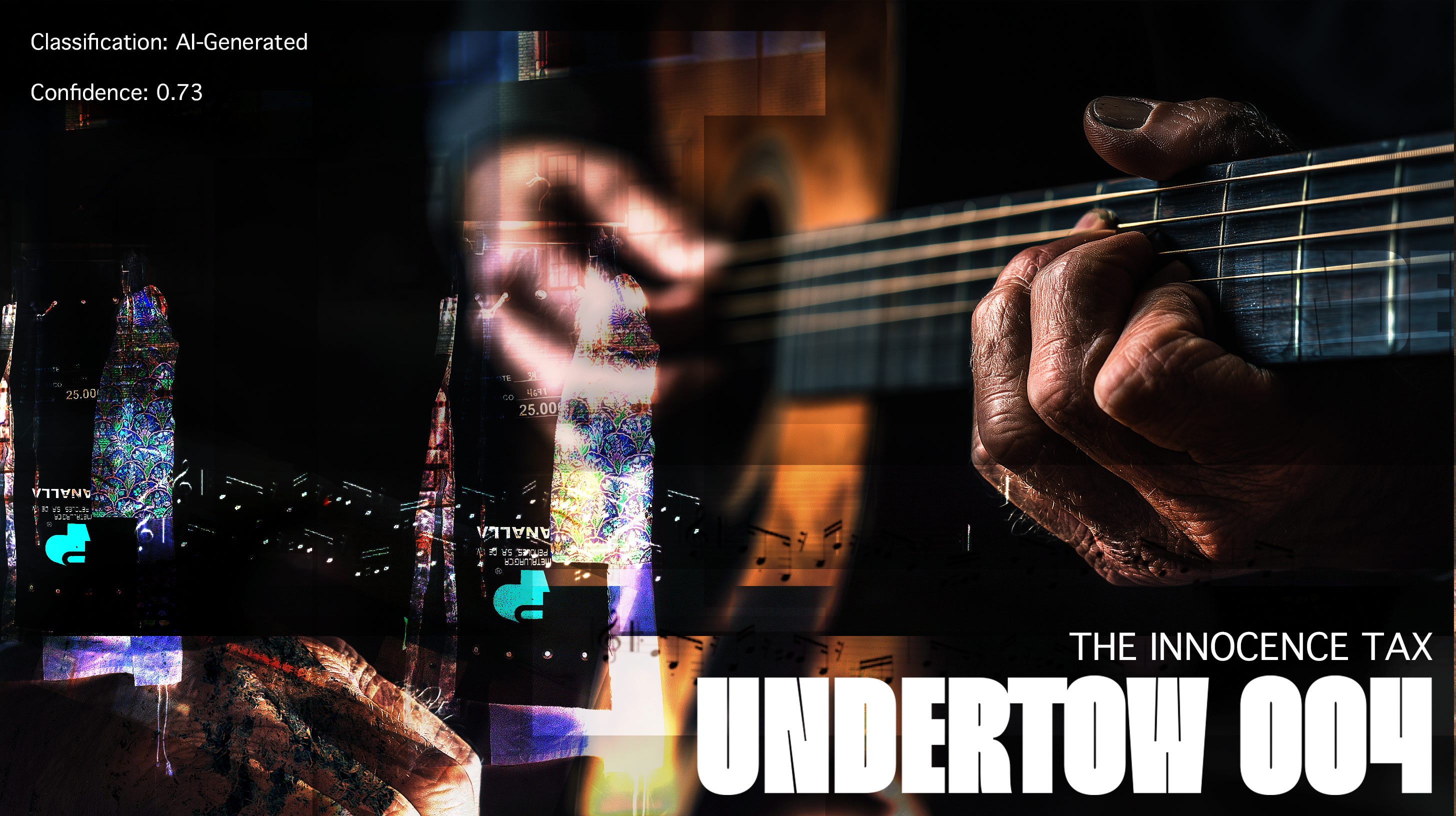
Marcin Patrzałek is 25 years old and widely considered one of the most technically gifted acoustic guitarists alive. Close your eyes and it could be four people playing multiple parts simultaneously. But it’s just him, on a single instrument. Marcin has been playing international stages since he was a teen. His technique is so unbelievably precise that people on the internet decided he must be faking it — editing, overdubbing, playing to a pre-recorded track.
So he posted a video. Not to teach. To prove, frame by frame, that his hands are the ones making the sounds. A man whose entire skill is doing something phenomenal in front of people with his body now has to provide supplementary documentation that the body is his.
At Liberty University, a student named Carr ran every assignment she wrote through Grammarly’s AI detector before submitting. Not because she used AI. Because she needed to confirm the detector wouldn’t flag her. She nerfed every sentence that triggered a score until the software cleared it. “I’m writing just so that I don’t flag those AI detectors,” she told NBC News. She later left the university. Not because she got caught cheating. Because the process of proving she wasn’t cheating replaced the process of learning.
Several freelance writing platforms required their writers to use Grammarly. Grammarly’s AI-powered suggestions altered their text. The platforms’ own AI detectors then flagged the altered text as AI-generated. The platforms fired the writers. No, because — the employer required the tool. The tool changed the work. The employer’s detector flagged the changes the tool made. The employer fired the employee. Everyone involved was following the rules. There were no rules that made sense to follow.
ProofIDidIt.com is a real website that exists in 2026. This is not a bit. An artist schedules a live video call with a human being whose job title is “Prover.” The Prover watches the artist draw in real time. When the drawing is finished, the Prover compiles an audit trail, generates a cryptographic hash, and writes it to a blockchain. To prove you painted something with your own hands, you now need: a human witness, a video call, a cryptographic signature, and a distributed ledger transaction. The previous technology for this was... just holding it up.
ProofIDidIt isn’t a creative platform. It’s a filing service. The Prover isn’t witnessing art. The Prover is notarizing a return.
The Tax
Four people. A guitarist, a student, a freelancer, an artist. Four different industries, four different countries, four different problems. Same receipt.
They’re all proving the same thing: that they did the thing they actually did. And they’re all paying for the privilege.
Call it the Innocence Tax.
The Innocence Tax is the cost you pay to prove your output is human in a world where AI authorship is the default assumption. It’s paid in money (subscriptions, certifications, compliance). It’s paid in time (process documentation, appeals, recordings, blockchain transactions). And it’s paid in creative quality, which is the part that’s not being measured yet.
The tax is regressive. The people paying the most are the ones who can least afford it.
And like every other tax, it has brackets. If you’re a student, you pay in rewritten essays and $50-a-month subscriptions. If you’re a freelancer, you pay in pre-screening rituals and lost contracts. If you’re a mid-career creative, you pay in the slow realization that your rate now includes an authenticity surcharge your younger competitors don’t carry. If you’re established enough, you’re exempt. The brackets aren’t published anywhere. Everyone knows them.
The Price List
150 “humanizer” tools are currently on the market, charging up to $50 a month. Their customers are not, primarily, people who used AI and want to hide it. Their customers are people who didn’t use AI and need a machine to believe them. Turnitin issued a software update in August 2025 to detect humanized text. The humanizers responded with keystroke simulation: software that doesn’t just rewrite your text but types it out character by character, faking the rhythm of human fingers on a keyboard, to prove that a person typed it. Humanwashing.
Erin Ramirez, an associate professor of education at Cal State Monterey Bay, put it plainly to NBC News: "Students now are trying to prove that they're human, even though they might have never touched AI ever."
On Reddit, students share their detector scores the way a previous generation shared credit scores. “Got a 2% AI probability on my psych paper.” “I’m at 11, is that cooked?” The anxiety is numeric now. Your authenticity has a score, and the score is never zero, and you check it the way you check your screen time — compulsively, knowing that the number doesn’t capture anything real but also knowing that the number is the only thing that matters.
The humanizer tools, the certification startups, the blockchain-verification platforms — they are the H&R Block of the Innocence Tax. They don’t reduce the burden. They monetize it. The detection companies build the apparatus. The compliance companies sell the workaround. Both sides profit. The only people who pay without earning are the ones filing the return. Which is to say: the ones producing the work.
A Vietnamese artist who goes by Ben Moran spent 100 hours painting a book cover. He was paid $500. He had every process file, every layer, every revision saved. He posted the finished work on Reddit’s r/Art. Banned. Moran posted his .PSD files. His layer history. His reference photos. Everything short of a Face ID scan. Didn’t matter. The verdict was in before the evidence was reviewed. One commenter: “I don’t believe you. Even if you did paint it yourself, it’s so obviously an AI-prompted design that it doesn’t matter.”
The guilt has detached from the act and attached to the aesthetic. You can do the work by hand and still fail the test, because the test isn’t measuring what you did. It’s measuring what the machine thinks human work is supposed to look like.
At Dragon Con 2025, an AI art vendor presented a fabricated process video — an AI-generated timelapse — as proof that the work was hand-made. Convention staff and Atlanta police supervised the removal. The empty booth became a shrine. Someone taped a sign to it: “VENDOR REMOVED FOR SELLING A.I. ART #ARTBYHUMANS.”
The proof-of-human system was defeated by AI generating the proof of humanness.
At some point you have to admire the circularity.
The same capability that made us say holy shit now makes us say prove it.
The Assignment Is Dead
The institutions are paying the tax too. They’re just sending the invoice to teens.
Instructors at Carnegie Mellon’s Tepper School of Business have eliminated take-home writing assignments. Not because writing stopped mattering to business education. Because they can no longer verify that a student wrote it, and they would rather eliminate the assignment than solve the verification problem.
The take-home essay — the OG assignment of liberal arts education, centuries old, the thing that taught generations how to think by making them write — is structurally dead. Not because it stopped working. Because nobody can prove it’s still working.
“I don’t write for the assignment anymore,” a student put it online. “I write for the detector. The assignment is just what I write about.”
In Seoul, the pressure runs the opposite direction. After mass AI cheating scandals hit South Korea’s most elite universities in a single semester, a student told the Korea Herald: “Everyone around me uses ChatGPT or Gemini to finish their university tasks. It’s to a point where not using the tool almost makes you feel stupid.” The Innocence Tax, Korean edition: if you don’t use AI, you’re the one falling behind. If you do, you’re the one cheating. There is no tax-exempt behavior.
The Machine’s Definition of Human
On a TikTok with a few hundred thousand views, a student advised peers to prompt ChatGPT with: “Write it as a college freshman who is a li’l dumb.” The goal: produce text that reads as plausibly mid, because detectors associate sophistication with AI.
That advice is darkly rational. The detectors flag writing that is too clean, too structured, too consistent. Their model of “human” is a model of a human who makes mistakes, who rambles, who occasionally writes a bad sentence. If your writing is too tight, the machine gets suspicious.
Students who never used AI are learning this. A parent described, on Techdirt, their child spending an afternoon removing vocabulary words from an essay, sentence by sentence, until the school Chromebook’s detector stopped flagging it. The assignment was about a story warning against the forced suppression of excellence. Naturally.
The detection infrastructure doesn’t discover who used AI. It produces a definition of humanness and penalizes anyone who doesn’t match it.
Non-native English speakers are flagged as AI-generated at a rate above 60 percent. Native speakers: close to zero. Not because non-native writing is AI-generated. Because it doesn’t match the statistical model of what the detector learned to recognize as human. In any other domain, a disparity that extreme in false accusations against a demographic group would trigger a federal investigation. In AI detection, it’s a known limitation listed on a product FAQ page.
The machine’s idea of “human” is a specific kind of human. Everyone else gets audited.
The pressure is working. Students are writing in a new register — not their own voice, not AI’s voice, but the voice the detector will believe is human. They have a word for it. They call it “writing clean.” Not clean as in clear. Clean as in: won’t trigger anything. The way you’d say a pee test came back clean.
The language of innocence borrowed from the language of surveillance.
We are learning to create like what the machine thinks a person sounds like.
Call it the detector voice. The aesthetic of compliance — creative output optimized not for quality, not for originality, but for passing the authenticity test. The Innocence Tax is what you pay. The detector voice is what you become.
A voice takes years to build. Anyone who has ever made something knows this. You write a thousand bad sentences before you write the one that sounds like you, and it’s still not finished, and that’s the whole point. That’s what a voice is. Something alive. Something still becoming.
The detector voice replaces all of that with a single question: will this pass?
Not is this true. Not is this good. Not is this mine.
Will this pass.
The Innocence Tax is what you pay. The detector voice is what you become.
Jane Doe is a student at the University of Michigan. She has generalized anxiety disorder and obsessive-compulsive disorder. Her writing is formal. Structured. Consistent. Those are symptoms of her condition.
The AI detector read those symptoms as evidence of machine generation.
Her condition makes her life harder every day. The machine read that difficulty as proof she doesn’t exist.
Her instructor posted publicly: “I fear that grading has made me paranoid and inclined to see AI everywhere.”
The instructor admitted the paranoia. The student is the one being punished for it. She filed a federal lawsuit in February 2026.
A Yale executive MBA student was flagged by GPTZero, suspended, and according to court filings, pressured to confess. He sued Yale for intentional infliction of emotional distress.
A student at LSU received a zero after her professor marked her work as "93% AI written." She didn't use AI. The appeals board was backlogged. They sent an automated message: her case manager would "get to you when she gets to you." Her scholarship required grade submission before the appeal could resolve. Her father wanted to hire a lawyer. The family couldn't risk it. She admitted to using AI she never used.
Some of them fight. Most don’t. The student who rewrites her essay until the detector clears it isn’t choosing compliance. She’s doing the math: the cost of fighting the accusation exceeds the cost of performing innocence. That’s not a choice. That’s a plea bargain. The creative economy has imported the presumption of guilt without any of the procedural protections — no counsel, no right to confront the accuser, no neutral arbiter. Just an algorithm, a score, and a burden that falls entirely on the accused.
The tax doesn’t fall evenly. It falls hardest on the people already paying something else: the non-native speaker navigating a second language, the student managing a disability, the freelancer with no institutional protection, the independent artist with no gallery to vouch for them.
The Innocence Tax is regressive the way sales taxes are regressive. Everyone pays the same rate, but the rate costs some people their careers.
Her condition makes her life harder every day. The machine read that difficulty as proof she doesn't exist.
Six Labels, No Standard
Six companies are currently selling the promise that your creativity is provably human. Humanmade.art. Humanable. I’ve Made This. HUMA Certificate. Done By Humans. MindStar. None of them agrees on what the proof looks like.
I’ll save you the comparison to organic food labeling. Everyone makes it. It’s wrong. Organic labeling works because there is a physical, testable difference between organic and non-organic produce. The difference between human-written and AI-written text is converging toward zero. The certification is verifying a process, not a product. The only witness to the process is the person being evaluated. This is less like organic labeling and more like paying someone to notarize that you had an original thought.
Six companies competing to become the IRS of authenticity. None of them has jurisdiction yet. All of them are collecting fees.
In Japan, a developer named Tochi took a different approach. In January 2026, he launched TEGAKI — a Pixiv-like art platform that bans all AI-generated images and lets creators authenticate their work as hand-drawn by submitting timelapse videos and working files. The name means “hand-drawn” in Japanese. He expected 50 users at launch. Five thousand registered on day one. TEGAKI isn’t selling certification. It’s building a walled garden where the old presumption still holds. The demand tells you everything about what the tax costs: five thousand artists paying with their presence for a space where being human is still the default.
Proof-of-humanness is becoming a luxury good. Gatekept.
You can already see the tiers forming. The mass market absorbs AI-augmented output as default. A small, expensive, certified-human tier rises above it. And the middle — the mid-career creatives too expensive to compete with AI, too unknown to command the “provably human” premium — gets structurally eliminated. Not by AI replacing them. By the cost of proving AI didn’t.
The Tax Gets Codified
On August 2, 2026, the EU AI Act’s Article 50 enforcement begins. Mandatory AI content labeling. Penalties up to 15 million euros or 3 percent of global turnover. European AI startups are already spending up to 330,000 euros on compliance. Four months out, only 35.7 percent of managers say they feel prepared.
Meanwhile, Blackboard — the platform provider that universities actually run on — has publicly called AI detection "a lost cause." The company that sells the infrastructure is walking away from the premise.
The regulation is supposed to solve the problem by requiring AI content to identify itself. Instead, it formalizes the presumption flip. Once the law says you must label AI content, the absence of a label becomes a claim of humanness — except the absence of a label is also exactly what unlabeled AI content looks like. The Innocence Tax becomes statute. It doesn’t go away when the detectors improve, because the detectors aren’t the problem. The presumption is the problem. And the presumption has already flipped.
Who Collects
We are the tax collectors.
Every time we ask a younger creative “did you use AI for this,” we levy the tax. Every time we run vendor work through a detector before approving it, we levy the tax. Every time a brief requires “proof of human process,” we build the apparatus. We didn’t design the surveillance infrastructure. But we operate it daily.
I work in creative leadership. A year and a half ago, when someone on the team made something with Midjourney, the room’s reaction was pure stoke. We weren’t asking if AI did it. We were blown away that AI could do it. The Slack channel blew up. We said holy shit. We experimented together.
I don’t know exactly when the question changed. But it changed. Somewhere between then and now, “did AI do this” stopped being wonder and started being accusation. The same capability that made us say holy shit now makes us say prove it. And the person on the other end of that question isn’t a tool or a platform. It’s a younger creative who made something good enough to trigger the doubt.
I have collected the Innocence Tax. I have also, if I’m honest, conducted audits on people who didn’t owe it. So have you.
Here’s what it costs, and I don’t mean the money. Every hour a creator spends documenting their process is an hour they don’t spend on the work. Every essay a student rewrites to sound worse is an essay that taught them to distrust their own voice. The tax is not just regressive. It is extractive. It takes creative capacity out of the system and converts it into compliance.
The next time you’re about to ask someone to prove their work is human, calculate what that question costs them. Not the money. The work they won’t make while they’re busy proving they made the last one.
The Pricing Tier
Here’s the bet.
Within eighteen months, “provably human” will be a pricing tier in at least three major creative marketplaces. Not a badge. Not a filter. A pricing tier — the way “organic” works in grocery, the way “handmade” works on Etsy. You will pay more for certified-human creative work. Not because it’s better. Because the certification is expensive, and the expense gets passed to the buyer.
And here’s the counter-bet, the one nobody in detection wants to hear: accuracy will improve. It will not matter. The Innocence Tax persists not because the tools are bad but because the presumption has flipped, and no tool un-flips a presumption.
The people exempt from the Innocence Tax will be the people who were always exempt from proving themselves: the established, the credentialed, the famous enough that their name is the provenance. Nobody asks Young Miko, Noga Erez or Billie Eilish to show their process files. Their fame is a permanent exemption. The rest of us file quarterly.
The Proof
Watch Patrzałek’s video. It’s at the end of this report. Not for the proof. For the playing.
He was forced to make a video. What he made was better than proof. The demonstration of technique became a performance of technique. The evidence became art. The thing the system demanded — show us your process — produced something the system couldn’t have anticipated: a piece of work so astonishing that the question of whether it was real stopped being the interesting question. The interesting question became how any human being could do that with ten fingers and six strings.
That’s the move the Innocence Tax can’t account for.
The tax assumes a transaction: you are accused, you provide proof, the proof is evaluated, you are cleared or condemned. It’s procedural. It expects compliance. What it doesn’t expect is someone who takes the demand for proof and turns it into the best work they’ve ever done. Not documentation. Not compliance. Something so undeniably, stubbornly, irrationally human that the verification framework breaks down because the framework was never built to encounter this. It was built to process claims. It has no category for transcendence.
I’ve spent decades making things for a living. The one thing I know about creative people — the thing no detection algorithm will ever model — is that when you tell them they can’t do something, or that what they did doesn’t count, or that they need to prove they’re real, some of them will collapse into the detector voice. They’ll comply. They’ll dumb it down, document it, notarize it, get the blockchain receipt.
But some of them will do the other thing. They’ll make something so damn good that the question answers itself.
The Innocence Tax is real. It is regressive. It is accelerating. The presumption has flipped. The cost falls on the people who can least afford it. All of that is true, and none of it is going away.
But here’s the design principle, and it’s the one I’d brief any creative team, any product team, any person sitting in a room wondering whether the work on the screen is human:
Don’t prove you’re human.
Be so human the proof is beside the point.
Make the thing only you would make. The sentence only you would write. The brief nobody else would think to write. The product feature that could only have come from someone who has sat in the specific chair you’re sitting in and seen what you’ve seen. The work that carries your fingerprint not because you documented your fingerprint but because the fingerprint is in the thinking, in the strange connections, in the thing you noticed that nobody else noticed because nobody else has lived your specific life.
The detectors will improve. The certifications will consolidate. The tax will get codified and collected and passed along. All of that is coming. And none of it will solve the problem, because the problem was never detection.
The problem is that we forgot what human work actually looks like. Not clean. Not consistent. Not optimized. Alive. Weird. Marked by the specific consciousness that made it. The kind of thing that makes you stop and wonder how a person could do that.
The way you stop when you watch Patrzałek play.
What To Brief From This
If you’re working on a brand that claims “authenticity” or “human-made” in its positioning, pressure-test it with the Innocence Tax question before you go to market. Who pays the cost of proving that claim? If the answer is your freelancers, your vendors, or your junior team, you’re building a brand promise on a regressive tax. Brief the cost, not just the claim.
If you’re evaluating creative work and the first question in the room is “did a person make this” instead of “is this good,” you’ve replaced quality evaluation with provenance evaluation. The work gets optimized for auditability, not impact.
If you’re building a product that involves content detection, moderation, or authentication, the Innocence Tax framework should be part of your design review. Ask: does this product create a cost that falls disproportionately on the people least able to bear it? If non-native English speakers are being falsely flagged at a rate above 60 percent while native speakers are near zero, that’s not a known limitation. That’s a design failure.
If you’re a strategist writing a brief in a category where “human” is becoming a differentiator — luxury, craft, education, creative services — brief for the world where the presumption has already flipped. Don’t assume the audience believes the work is human. Assume they don’t, and design for re-earning that belief without making the creator bear the cost.
If you’ve ever asked someone on your team to prove their work is human, forward this to the person you asked. They’ll recognize the tax. You might recognize the collector.
So far, not hearing haters accusing Takuya Nakamura. Short clip w/ some live trumpet magic while playing a set at The Lot Radio.
Did not know he studied Jazz Theory in Boston. UK Jungle, represent!
https://x.com/TheCartelDel/status/2039751129479930111?s=20
The full set on YouTube here: https://www.youtube.com/watch?v=skR7nv1zfmg