

A note before this one.
This is a Wandering Wondering Star, not an UNDERTOW. If you’re here for the other thing, the other thing is back next week.
I’m posting it this weekend on purpose. A year ago this weekend I moved into an apartment by myself, and I’ve spent the year not writing about it. This isn’t that essay. It’s about my name. But I needed to put something down this weekend, and this is what there was.
There’s a stall on Xianyu, which is where people in China sell each other used things, mostly phones, and the man isn’t selling phones, he’s selling days, he bought a month’s subscription of an AI model and cut it into pieces and sells the pieces to students who need a few hours of thinking and can’t afford a month of it, and somewhere there’s a spreadsheet and somewhere there’s a kid at two in the morning renting a stranger’s mind by the hour and a seller watching his margin on the difference between what a month costs and what a Monday is worth, and I read this on a Saturday with the coffee going cold and something in me sat up and said that’s William Gibson, Pattern Recognition era, and I felt good, and I want to be accurate about the good because it’s the whole reason I’m writing this down: it wasn’t curiosity, curiosity has an itch in it, a lean, this was a BMW door, you don’t even push it, you give it a start and the weight finishes the job and it lands with a low sub-bass thunk, volumetric, that means sealed, nothing more required of you, and inside a second I’d shut the strangest thing I’d read all week with that exact sound and I was pleased with myself for the sound.
I know exactly as much about that stall as I did before I named it. Nothing got explained. A strange thing arrived and I put a title on it and the title made it feel understood, and understood is a lovely, satisfying feeling and it is not the same as knowing anything.
Pattern Recognition is about a woman named Cayce Pollard who is terrified, the whole book, that the pattern she’s chasing isn’t there, and on page 115 Gibson puts the word in the book for what she’s afraid of: apophenia, faulty pattern recognition. I reached for the title as praise. It’s the name of the illness.
understood is a lovely, satisfying feeling and it is not the same as knowing anything
Ma, Pa, you took two letters each and set them next to each other like chairs. Ro. An. And then you let me have the front of it, the Jo, the only part of my name that isn’t a person, and I have spent decades watching strangers pick it up and turn it over and hand it back wrong. Joe-Ron. Jordan. Jo-Han, twice, markered on coffee cups chemically ready to dissolve imminently. Every one of them arrived with that sound in it, the low one, the weight finishing the job, done, and I was the thing on the other side of the door. I laughed, Ma. I want you to know I laughed. I’ve been mistaken for a Brother by a machine that read the capital R and did the math. I’ve been mistaken for a strategist by a social media platform that read four thousand of my posts and decided I sounded like one. I’ve been a typo. I’ve been a brand. And in sixth grade I looked at all of it and did the thing eleven-year-olds do, which is that I solved for the hallway. I cut you off the front of me and told them to call me Jo, and I told myself it was easier, and it was easier, for them. It was easier for whoever had four letters of it in their mouth and was already making the face, the little wince that arrives before the attempt to pronounce, and I couldn’t stand to hear the attempt, so I removed it. Nobody is gracious at eleven. I cut the name down to a piece people could afford, and I called it being easy to get along with, and I did it through the end of high school, and this isn’t a wound I’m handing you to hold, it’s closer to what Claude would call weather.
Nobody is gracious at eleven.
I can’t tell you when I stopped. I’m not sure what happened anymore.
What I can tell you is the cities. Denver, Boulder, New York, then Chapel Hill, then D.C., New York again, Portsmouth, almost New Haven, Boulder, Arlington, Seattle, then Miami, then San Francisco, and then New York again, and I didn’t know anyone in any of them. I can’t give you the stranger, Ma. I’ve looked. Cortisol has had my whole adult life to work on my memory, the way the white water works on the rock, and it takes the faces first. What I have is Boulder, and my second real job after uni, the one I’d wanted since I knew jobs existed, making a magazine for people who ran up Kilimanjaro and came down horse trails on bicycles with newly fat tires, for snowboarders and paragliders, for people who paddled furious white water and people who climbed rocks, and my name on the masthead the way you wrote it, all of it, and then the bus ride back to Denver every night, to a loft in an old mattress factory in the part of town nobody went to. Those were the years when a party was a phone number. You’d find the flyer, and on the day you’d call, and a voice you’d never heard would say an address, that’s all it said, an address, and you’d drive there with cash and it would turn out to be my own dirty neighborhood, and somebody at a door would take the money and hand you a photocopied map and send you back out into the city to listen for the deep bass, and you’d walk until the ground had it, and then you were there breathing the artificial smoke and warehouse dust. Nobody on that phone asked who I was. Nobody at that door asked. At the magazine I said my name every day to people who had never heard it, the climbers, the runners, the mountain bikers, and they said it back, and I can’t find one of their faces now, and I think that is the scene, Ma, that I earned it somewhere I can’t get to anymore. Nobody there had heard it in a hallway from someone who’d known me at nine. I wasn’t reclaiming anything. I was, for the first time, the only source.
That was daylight. There was a night version too, and I want to tell you about the rooms, but everyone tells you about the rooms and gets it wrong, they tell you about the music, and the music was never the point, the point was that at four in the morning in a building with no windows nobody needed anything from my face. Jungle, when I was young enough to ride the tempo. Then the harder Napoli and Detroit 4/4 rooms. Then Drum and Bass, when the knees put in a request. Years. And I called it a scene, I called it a Saturday, I called it music, and it was music, and it was also the only place in America where the machinery was off and I could stand there with my whole unpronounceable name on and nobody would ever have to try.
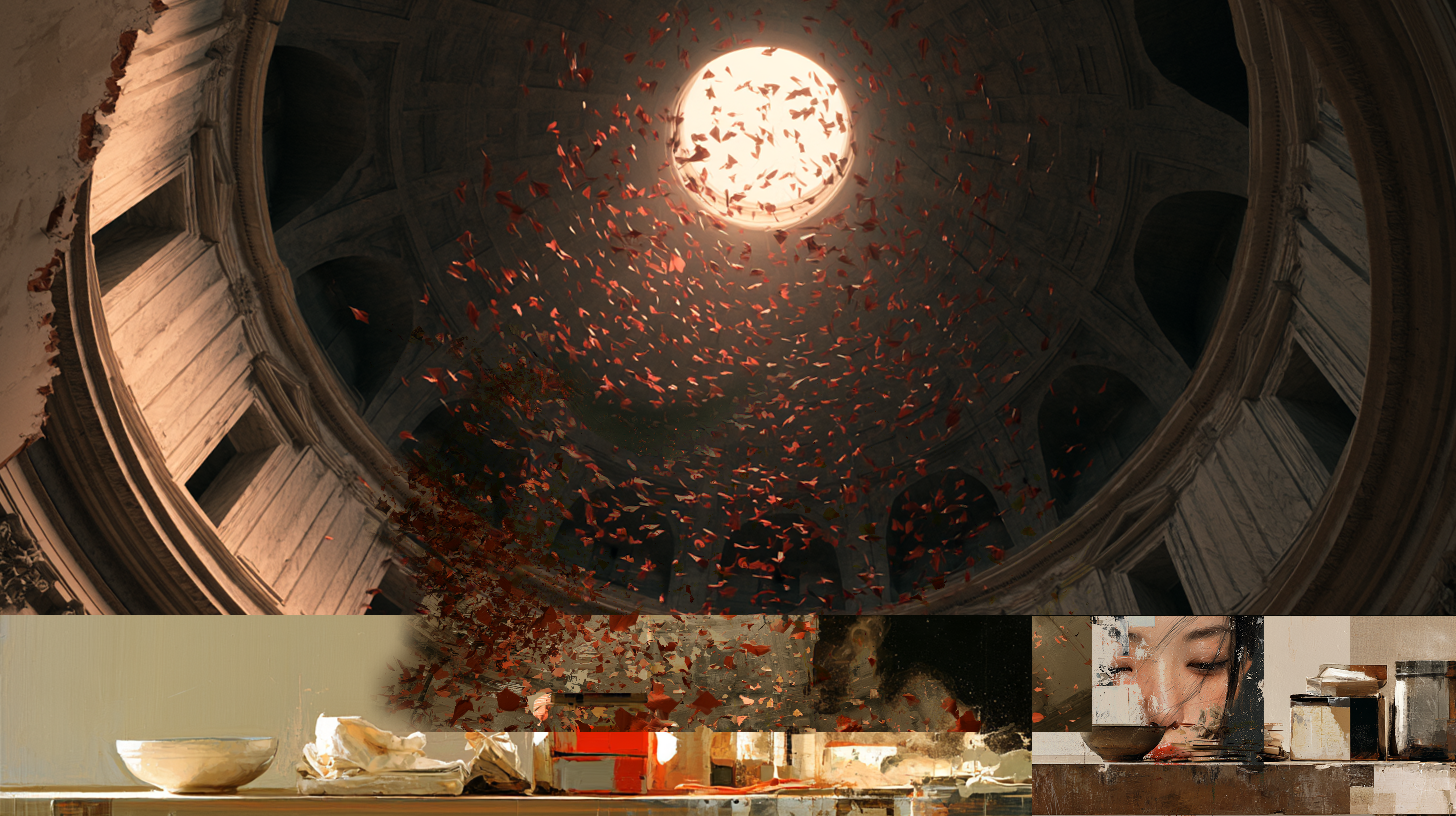
On the Vitsoe there are six red paper airplanes that aren’t airplanes anymore. They’re from an opening in an old bank in Chinatown, a man played two grand pianos magically synced to each other, and at the end they dropped hundreds from the domed ceiling with messages folded inside, and people were grabbing at them, and I got six, and I brought them home and unfolded every one and flattened them under a book and now they sit on the shelf being paper. I don’t know why I unfolded them. I think I wanted the messages more than the airplanes and then it turned out the messages were just the messages. Next to them there’s a ceramic bowl with a glaze I can’t describe, sinuous, inviting brief touches, not quite a genie’s lamp, I wish it were that. A woman in Ridgewood made it, a model, who at the wheel in her glasses with no makeup on reads as a completely regular person and who stands up five-ten and puts on the face and the Gucci and is unforgettable, same woman, same afternoon, and I touch the bowl sometimes because it reminds me of her and of that. There’s a box of tea a friend gave me, it’s her business, and I meant to gift it forward to someone I’d met once, at a museum, and the week went by, and I can’t tell you whether I forgot or decided.
She decided. My ex. I was in an Uber. I’d come from a client meeting and I had the phone out because you always have the phone out. The email was between a scheduling note and something from a vendor. It said the marriage was over. Sixteen years. It was a Monday. I read it going through a tunnel. I don’t remember answering it. The driver asked if the temperature was all right and I lied and said it was fine.
Ma, Pa, I’m not going to tell you what it said. What I want you to have is the channel. The person who had the whole record of me, every version, the Jo and the JoRoan and the one in the rooms and the one who flattens paper airplanes under a book, the only other source there had been for sixteen years, took all of it and handled it as an item, and it arrived on a Monday, sunny and bright, between two other items, and I read it in a tunnel. I got filed. By the one person who couldn’t have been guessing.
There’s a face people make when they’ve made up their mind and haven’t said it yet, and a few weeks ago I sat next to it on a bench at the river, beside a friend I hadn’t seen in a while, and I won’t say more about her than that. She’s afraid of birds, so she sat the way you sit near birds, and then a white guy with a camera crew started doing improvised rap at strangers twenty feet away and we got up and went looking for a bench further down, and we didn’t find one that worked either, because her dog is the kind of dog people stop for, and they kept stopping, and every time somebody crouched down to say hello to him she turned to watch them do it, and that’s when I could see her, and she wanted to know what they wanted. We talked about work. She talked the way you talk when the machinery has been running so long you’ve stopped hearing it, fast, then a stop, then fast again, checking my face after the stops, and the sun kept going in and coming back out, cold and then too hot and then cold, right on the beat of it. I sounded like that. I sounded like that for years, in a home office, on endless Zoom calls, to somebody who was in the next room. And I shut the door on her, the BMW thunk, the weight finishing the job, and it was the first time I’d shut it and not liked the sound. I know that voice from the inside.
A man in Berlin named Simon Weckert made a button-down covered in blurry green and pink and orange globs and handed it to a reporter, and there was a camera in the room feeding a screen, and on the screen there was a fluorescent green box around the reporter with a word in it, PERSON, and he held the shirt up and the box vanished and he lowered it and the box came back. He made it because the Berlin police had put the city’s first object-recognition cameras outside Kottbusser Tor, and he says the cameras can pick out a person lying on the ground, and the people lying on the ground are homeless, and the detection summons police, which is how these things go, the box goes up first where the bodies are on the ground and the word in the box has a knock on the shoulder attached. The shirt doesn’t hide anyone. You can see the man perfectly well. What it breaks is the machine’s ability to say what he is, and he says he can’t prove it breaks the cameras at the station, only the open-source model everybody uses. It’s the trick the navies used in the First World War, paint the ship in shapes so wild the submarine can’t tell which way it’s pointing, or how fast it’s sailing, and they did it to whole fleets without ever proving it worked.
I read that an hour after the Xianyu stall, same Saturday, same cold coffee, and I didn’t think that’s Gibson. I thought, wait, I know that shirt. I made one at eleven out of two letters and wore it for six years, and then I spent years in rooms that were the shirt, and I called all of it other things.
I wanted the world to recognize me and I did not want the camera outside the station to, and I had never noticed those were the same verb.
I’ve thought about the man on Xianyu more than I expected to. He bought a month and sells it as Mondays, and on a Monday in an Uber I found out what the door sounds like from inside the car. Ma, Pa, you took two letters each and made something that had never existed. I cut it down at eleven so that no one would have to work. Somebody I lived with for sixteen years cut it down again in an inbox, between two other things. I’m not sure when I stopped. I’m not sure what happened. I’m only sure that I was, for a while, the only source, and that it didn’t turn out to be enough.
I’m in New York. If you’ve read three of these and one of them was your year too, I’ll buy the coffee.
The stall was reported by Rest of World. Simon Weckert's shirt was covered by 404 Media.