

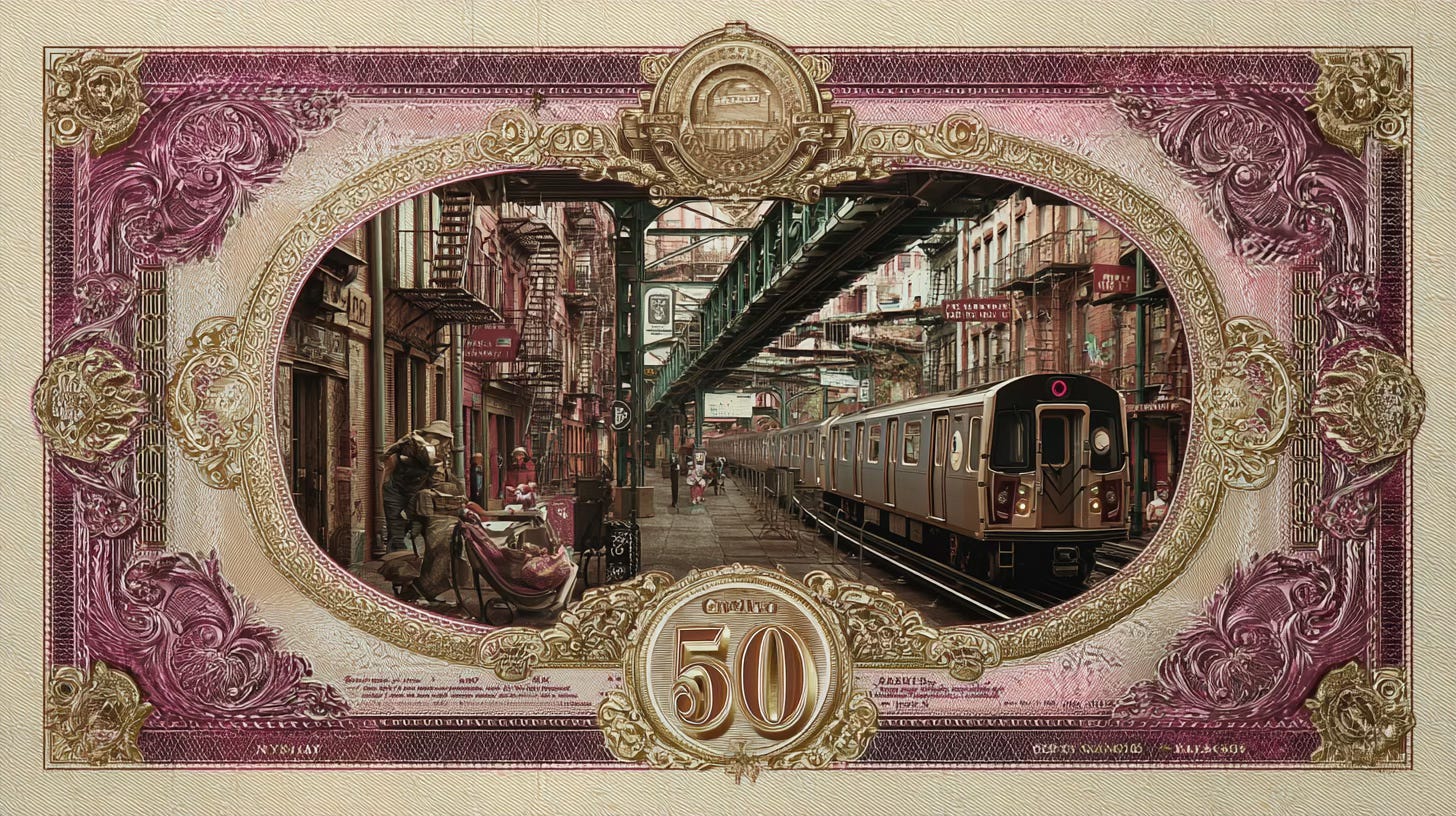
The last time I felt genuinely close to another person it was on Kosciuszko Street, a woman trying to get a stroller up the subway stairs while holding a bag of groceries and a phone between her ear and her shoulder, and I grabbed the front end of the stroller without asking and we carried it up together, and at the top she didn’t say thank you, she said “my back is done, I’m twenty-nine and my back is done” and I said “my jaw clicks every time I open my mouth, I’m falling apart” and she laughed, not politely, actually laughed, and said “we’re all falling apart, my mother says it starts at twenty-five and doesn’t stop” and then the train came and she went one direction and I went the other and I never saw her again and I remember thinking: this is it. This is the thing. Not the deep conversation, not the exchange of names or numbers, but this, two strangers at the top of a staircase trading the small stupid inventories of what it felt like to be inside their particular bodies on that particular afternoon, an intimacy with a half-life of ninety seconds that somehow meant more than most conversations I’ve had with people I’ve known for years.
The last time. I want to sit with that phrase for a second because I wrote it without thinking and now it’s sitting there staring at me. The last time I felt genuinely close to another person was a stranger I spoke to for ninety seconds in a subway station. Not my friends, who I see regularly. Not the people I’ve lived with. Or called family. A woman with a stroller whose name I never learned.
Most of what we say to each other, if you actually listen, is just this. People taking turns complaining. And the instinct is to hear that and flinch, to read it as an indictment: we are boring, we are small, we waste our breath on trivia when we could be discussing art or politics or the meaning of existence. But I think the opposite is true. I think most of it is the meaning of existence, or at least the closest we get to it in practice, because what a complaint actually is, underneath the content, is a proof of life. A transmission: I am a body, the body is in a situation, the situation is wearing on me, and I am telling you because telling you means I believe you are also a body in a situation and that we share enough of a world for my wear to be understandable to yours. Human beings have built an entire civilization on the ability to trade their wear and tear with each other, my back for your jaw, my knee that sounds like a stapler for your shoulder that won’t rotate past three o’clock, and the exchange only works because both parties have actually been worn. That woman on the stairs didn’t need me to fix her back. She needed me to be falling apart too.
There’s a musician, Burial, the producer who, for a long time, wouldn’t show his face, who makes electronic music that sounds like it’s being played back from a tape that’s been left in the rain. The crackle in his tracks, the hiss, the way a vocal sample will surface like someone calling out from two rooms away and then drown again in static, none of that is a production choice in the way we usually mean. It’s not a filter applied for warmth. It’s what happens when a particular person, with a particular history of South London raves and night buses and 3am corner-shop fluorescence, tries to reconstruct not the events but the feeling of the events, and the feeling is inseparable from the degradation. The medium was always cheap. The tapes were always damaged. The signal was always bleeding through from something else, another night, another voice, another version of the city that doesn’t exist anymore. You can’t reproduce it with a plugin because the plugin generates the sound of damage without the damage. It generates the crackle without the biography.
You can’t reproduce it with a plugin because the plugin generates the sound of damage without the damage. It generates the crackle without the biography.
The conversation about AI and human meaning keeps circling the wrong objects. We keep talking about what AI will replace, and whether the replacements will be good enough, and whether a poem, a love song, or even a Super Bowl spot written and produced by a machine can move us the same way. But I don’t think the thing that’s actually at stake is the beauty of the finished ‘product’. I think the thing that’s at stake is the crackle. The wear. The complaining.
Here is what I mean and I want to say it fast, before I start smoothing it out: the thing I’m afraid of is not a machine that writes better than me, the thing I’m afraid of is a world where the specific damages that make people readable to each other start disappearing, not because AI simulates them but because the conditions that produced them get optimized away, the four-flight walkup, the grocery bag carried in the rain because you can’t afford delivery, the back that’s done at twenty-nine from hauling a stroller through a system built for people who don’t have strollers, all of it, the whole economy of ordinary physical ruin that we use to recognize each other, and what replaces it isn’t AI pretending to suffer, it’s a frictionless world where fewer and fewer people have the specific, bodily, ridiculous damages that used to be the common language. Not the simulation of crackle. The gentrification of it. The conditions of Burial’s South London scraped clean, the night buses that smelled like rain and rolling tobacco replaced, the corner shops with their fluorescent aisles of canned goods and phone cards closed, the cheap TDK tapes no longer manufactured, and the music that could only have emerged from that particular damage becoming impossible, not because nobody can make the sounds but because nobody will have lived the life that the sounds came from.
Not the simulation of crackle. The gentrification of it.
A friend of mine, we were at her kitchen table at maybe one in the morning, she’d had a few drinks, I hadn’t, and she said that the AI future felt like a place where even if we don’t die, it still feels like everything is coming to an end. And I remember the kitchen was cold because the heat in her Bushwick building was unreliable and it’s the second week of the Polar Vortex, and I could hear her upstairs neighbor watching “Singles’ Inferno” through the ceiling, and her chair had a wobble she’d fixed with a folded piece of an Amazon box, and I thought: this. This right here is the thing she’s afraid of losing. Not the conversation about AI. The cold kitchen. The bad chair. The neighbor’s TV bleeding through the floor like a ghost signal under the conversation we were actually having. The apartment she can barely afford that is falling apart in ways that make it specifically, irreplaceably hers. Clean signal doesn’t haunt. Clean signal doesn’t carry ghosts. You need the wear, the gap in the fidelity, the crackle, for one life to be audible underneath another.
The chatbot can’t say yeah, well, listen to what happened to me, and mean it, because nothing happened to it. But I want to be honest about something: I’m not sure the chatbot is the real problem. I have a friend who told me once that her hip pops every time she takes the first step out of bed in the morning and I said something like “that’s rough” and changed the subject, and the exchange rate failed, it just failed, because I had the damage to trade and I didn’t trade it, I kept it to myself, I stayed clean signal by choice, and she noticed, and the conversation got thin, and eventually we stopped having conversations at all. I did the thing I’m afraid the machine will do. I offered smooth where she needed crackle.
I did the thing I’m afraid the machine will do. I offered smooth where she needed crackle.
I don’t think this is rare. I think this is actually the thing, the thing underneath the AI anxiety, which is that we were already failing at the exchange before the machines showed up. The machines just make the failure visible by being so good at the part that doesn’t matter, the validation, the reflection, the empathy-shaped response, that you can finally see how much of human closeness was never about empathy at all. It was about the willingness to say I am also falling apart and mean it.
Why was a ninety-second exchange with a stranger the closest I’ve come to feeling genuinely connected to another person? I have people in my life. I have conversations. I have all the parts of connection and most of it runs on clean signal, on competence, on the curated version of myself that functions well and doesn’t click when it opens its mouth, and I think what happened on those stairs is that I didn’t have time to curate. She was struggling, I grabbed the stroller, and then we were just two bodies at the top of a staircase and the only thing available to trade was the truth, which is that my jaw clicks and her back is done and we are both falling apart in a city that doesn’t slow down for falling-apart people, and the train was coming so neither of us had time to turn it into anything other than what it was.
I sneezed last week after clapping my hands too hard with climbing chalk and pulled something in my neck and it still hurts when I turn my head to the left. My right knee has started making a sound when I take stairs, not pain exactly, more like a fact. I can’t fall back sleep on my right side anymore and I don’t know why. These are the things I would have traded with the woman on the staircase. These are the things I almost never say to the people I actually know. And I think the reason I don’t say them is not that they’re trivial. It’s that saying them requires believing the other person wants to hear them, that your small ruin is welcome, that your crackle is worth receiving, and that belief, that willingness to be a damaged tape playing in someone else’s room, is the thing I keep losing, or never had, or had for ninety seconds on Kosciuszko Street and have been writing about ever since.
that belief, that willingness to be a damaged tape playing in someone else’s room, is the thing I keep losing, or never had, or had for ninety seconds on Kosciuszko Street and have been writing about ever since.
The last time I felt genuinely close to another person, it was a stranger at the top of a staircase. I don’t know what that says about the machines. I know what it says about me.
I love, love, love your writing. Thank you x
I loved this post. It was beautifully written.