

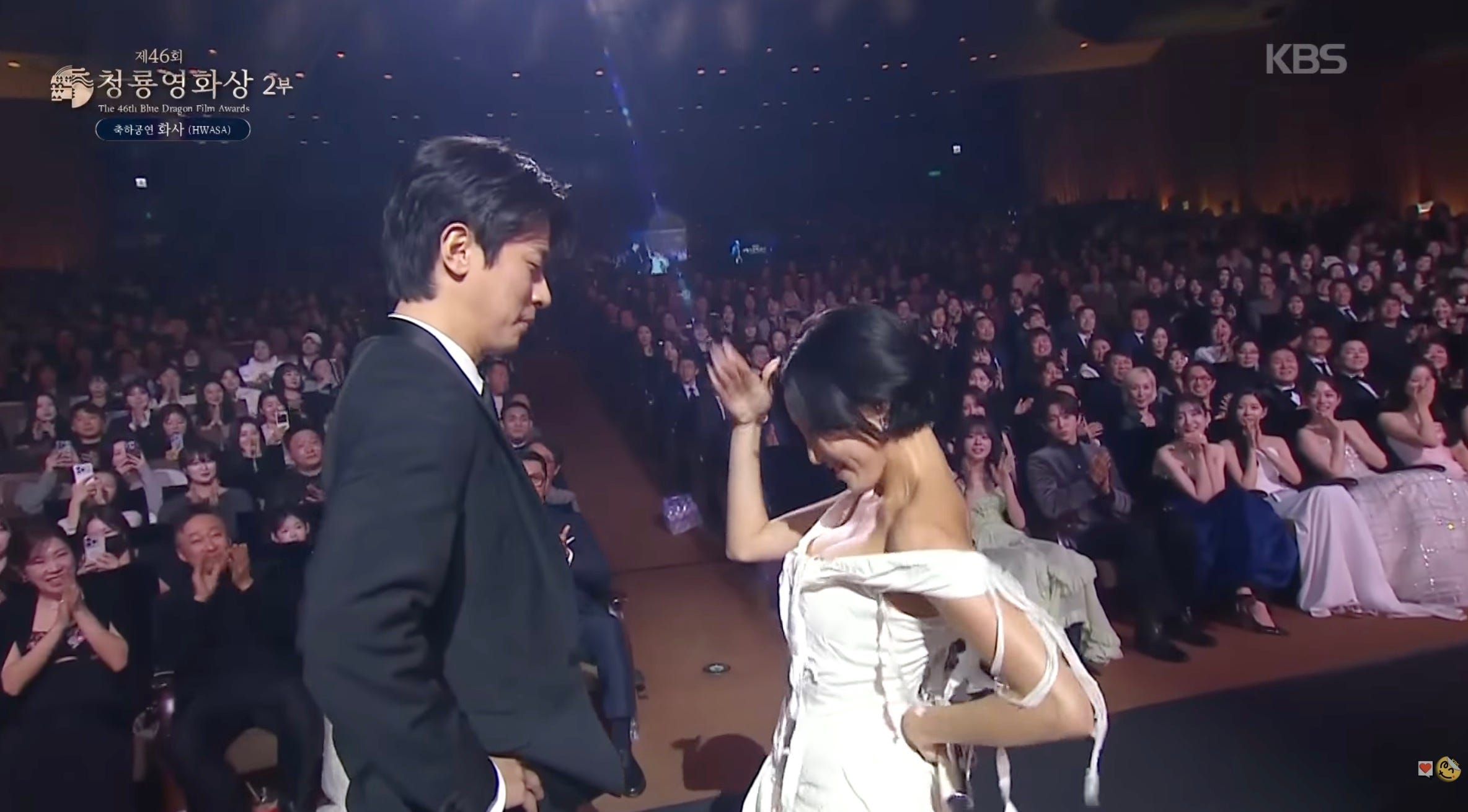
Last month, at the Blue Dragon Film Awards in Seoul, a singer named Hwasa performed a song called “Good Goodbye.”
She was barefoot. There was nothing on stage but a chair. The song is about heartbreak—about whether a clean ending is even possible, whether you can wish someone well when they’re already walking away.
Halfway through, actor Park Jeong-min walked out from the wings.
He’d starred in her music video. She’d called him, in interviews, her longtime crush. What happened next wasn’t choreographed. He crossed the stage to her. He held her red heels in his hands while she danced around him. And at some point they looked at each other—really looked—like the cameras weren’t there. Like something was happening between them that had nothing to do with the audience.
We just got to witness it.
The clip went everywhere. Fifty-three million views on the music video. The song shot to number one on every Korean chart. The first Perfect All-Kill by a female soloist all year. But what spread faster than the song was the moment itself. People started recreating it with their partners. Holding the heels. Doing the look. A performance became a template. A mediated moment became a script for something that looked like intimacy.
I’ve watched the video more times than I should admit. Different angles. Fan edits. The wide shot. The close-up. The one where you can see his face when she finally turns toward him.
Every time, I feel it. The catch in the chest. The recognition. The sense that something was meant.
Koreans have a word for this. 인연—inyeon. The universe destined us to meet. It comes from Buddhist philosophy a thousand years older than the algorithm. Causes and conditions across lifetimes. Nothing accidental. When you see two people and feel that uncanny certainty—something larger than them arranged this—you’re feeling inyeon.
It’s the same feeling I chase across four different streaming platforms. A surgeon who falls into a webtoon and loves the character her father drew. An app that lights up when someone within ten meters is in love with you—and the screen stays dark. A woman who remembers all eighteen of her past lives, finally finding the man she’s loved in every single one. He doesn’t remember her at all.
Netflix charges $17.99 for the feeling.
The feeling used to require a meeting. Now it just requires Wi-Fi.
TikTok's For You Page is just inyeon with better metrics.
Korean doesn’t just have inyeon. It has an entire diagnostic system for attraction. Three different words for three different ways your chest can tighten when you see someone.
한눈에 반하다 is the surface hit. You see them, they’re beautiful, your body responds before your mind catches up. It’s real, but it can evaporate the second time you meet and they’re just... a person. Koreans have a word for people who fall like this too easily: 금사빠. Not an insult exactly. More like a diagnosis.
끌린다 is darker. You’re being pulled toward someone—magnetized by something your conscious mind didn’t choose. The pull doesn’t care if they’re good for you. When someone says 끌린다 instead of “I like them,” they’re confessing something: I know this might hurt me. I’m going anyway. In K-dramas, it’s the moment you know someone’s about to walk toward their own destruction. They see it coming. They go.
And then there’s inyeon. The cosmic one. Not attraction exactly—recognition. The sense that your meeting wasn’t luck. That something had to align across lifetimes for you to be in this room together.
Three words. Three different futures. The first fades. The second destroys you. The third stays, even when you’re not together.
The precision is supposed to be a gift. Name the feeling accurately and you navigate it wisely. Know which type of falling you’re doing and you can choose whether to hit the ground.
But I’ve been reading about what Korean women are actually doing with all this gorgeous, precise language.
They’re not choosing among the three paths. They’re refusing to walk any of them.
In Seoul, women check public bathrooms for hidden cameras before they can pee. The epidemic of spy-cam footage is so widespread it has its own name—molka—and its own economy, its own viral distribution networks, a legal system that still treats the footage as property dispute rather than violence. Women watched their mothers live out the trajectories that 끌린다 and inyeon initiate. They saw where the wound-matching magnetism leads. Where the cosmic recognition lands you.
So they left. 비혼, 비출산, 비연애, 비섹스: no marriage, no childbirth, no dating, no sex. The 4B movement. Not a negotiation. An exit. Not “we’ll come back when conditions improve” but “we looked at the table, we understood what was being served, and we’re not hungry.”
Korea now has the lowest fertility rate on earth: 0.72 children per woman. The government has spent £164 billion trying to reverse it. The number keeps falling.
We looked at the table, we understood what was being served, and we're not hungry.
The precision was supposed to help women navigate. Instead, it gave them a detailed enough map to see the whole territory.
What do you do when you can see the whole territory?
There’s a Korean saying: 옷깃만 스쳐도 인연. Even brushing sleeves is inyeon. Even one conversation with a stranger you never see again. Something had to align for that moment to happen.
It sounds like surrender to something larger than yourself.
But if you squint, inyeon operates exactly like a recommendation algorithm. You were shown this person because of patterns you can’t see. The universe—or the machine—has calculated that this encounter is for you, based on data you don’t have access to. Your job is to trust the output.
TikTok’s For You Page is just inyeon with better metrics.
My theory: once a feeling becomes legible—once you can name it precisely—it can be extracted from its original context.
Korean vocabulary made attraction legible. Three categories that blur in practice, but the vocabulary still trains you to sort. And once the feelings were legible, they could be packaged, exported, sold back to you in a form that doesn’t require participation. The naming didn’t just describe the experience—it made the experience portable. Something you could carry without living.
K-dramas have cracked something about longing that Western television mostly fumbles. The slow burn, the almost-touches, the emotional maximalism that would feel absurd in an American show but feels true in a Korean one. The formula delivers all three types of attraction, in sequence, calibrated for maximum impact. Surface hit, dangerous pull, cosmic recognition—all of it, without risking any of it.
And the women watching at 2am in Seoul are often the same women practicing 4B.
I should be clear: I’m not observing this from a distance.
Four platforms. Exposed algorithm. I know exactly what I’m doing. Watching love stories because it’s cheaper than wanting something from someone who could actually disappoint me. The research was a cover story. The cover story was a lie I told myself so I wouldn’t have to say the true thing out loud.
The true thing: I don’t actually know how to feel things in real time. I learned young that feelings were expensive—that the safest way to survive was to bury everything that might slow you down. I haven’t properly cried in decades. Even when my life collapsed. I don’t know what I’m holding anymore—just that I’m still holding it. You can’t fall apart if there’s no one to help put you back together.
Watching K-dramas, I’ve come closer than I have in years. To grief. To the permission to want something I might not get.
I don't know what I'm holding anymore—just that I'm still holding it.
Something about the permission of it. Someone else’s longing, someone else’s loss, contained inside a screen. I can feel it move through me without it being mine. Without it threatening anything. I’m not avoiding feelings. I’m rehearsing them. Practicing in a place where nothing is at stake. Learning, decades late, what it might feel like to let something reach me—in a room where no one can see if I finally break.
English doesn’t have this system.
We say “falling in love” and the phrase is a mess. Passive, undifferentiated, vague about whether this is something happening to your body or your soul or your wounds or your fate. The phrase doesn’t diagnose anything. It just reports a sensation of descent.
I used to think this was a failure. Imprecision. The clumsiness of a culture that never developed vocabulary for its own emotional states.
But maybe the vagueness is protective.
If you can’t name exactly which type of attraction you’re experiencing, you can’t sort it into a category and evaluate whether that category is worth the risk. You can’t identify your feelings as wound-matching magnetism and google the outcomes.
Korean also has 정—jeong. The love that accumulates through dailiness. Not the thunderclap, not the cosmic arrangement. Just the slow accretion of having been with someone through ordinary time. Jeong isn’t diagnosed at first sight. It’s discovered years later, when you realize the person you’ve been sitting next to has become irreplaceable without either of you noticing.
But if you’ve already diagnosed your attraction as 끌린다—already labeled it wound-matching, already seen the pattern—you might leave before jeong has a chance to form. The label tells you what something is before it’s finished becoming.
English doesn’t let you diagnose early. So you might stumble into the accumulated love without ever having a word that told you to leave.
Korean reveals the mechanism. And once you see the gears, you can decide not to be one.
Somewhere in the last few months, being newly single crossed over from phase to fact. I’m still getting used to the view from here.
I tell myself I’m being careful. Discerning. That I’ve learned to read the patterns—to see 끌린다 for what it is before it can pull me into another collision.
But I think what I’ve actually learned is how to watch.
I still rewatch the Hwasa clip. I keep looking for the moment it crosses from performance into something real. When the cameras stop mattering and they’re just two people in a room. I still can’t tell. Maybe I don’t want to know. Maybe if I knew for certain it was real, I’d have to ask why I’m not looking for that myself.
I know all three feelings now. I can feel the exact moment in episode eight when the drama shifts from surface attraction to cosmic recognition. I feel it in my body—the tightening, the longing, the sense that something was meant.
And then I close the laptop and go to sleep alone.
I think we’re solving the same problem. They looked at the cost and said no. I looked at the cost and found a way to keep paying without ever arriving.
Or maybe that’s just what I tell myself so the watching feels like wisdom instead of hiding.
The universe keeps arranging meetings. I keep watching other people show up.
It’s not that I don’t want someone to stay. It’s that I’m still waiting for someone to walk out from the wings.
If you haven’t seen it, watch this one first. With the sound ‘on’. They didn’t rehearse the performance.
And then this one with the crowd reactions. Like the Oscars, the biggest stars sit in front of the stage.