

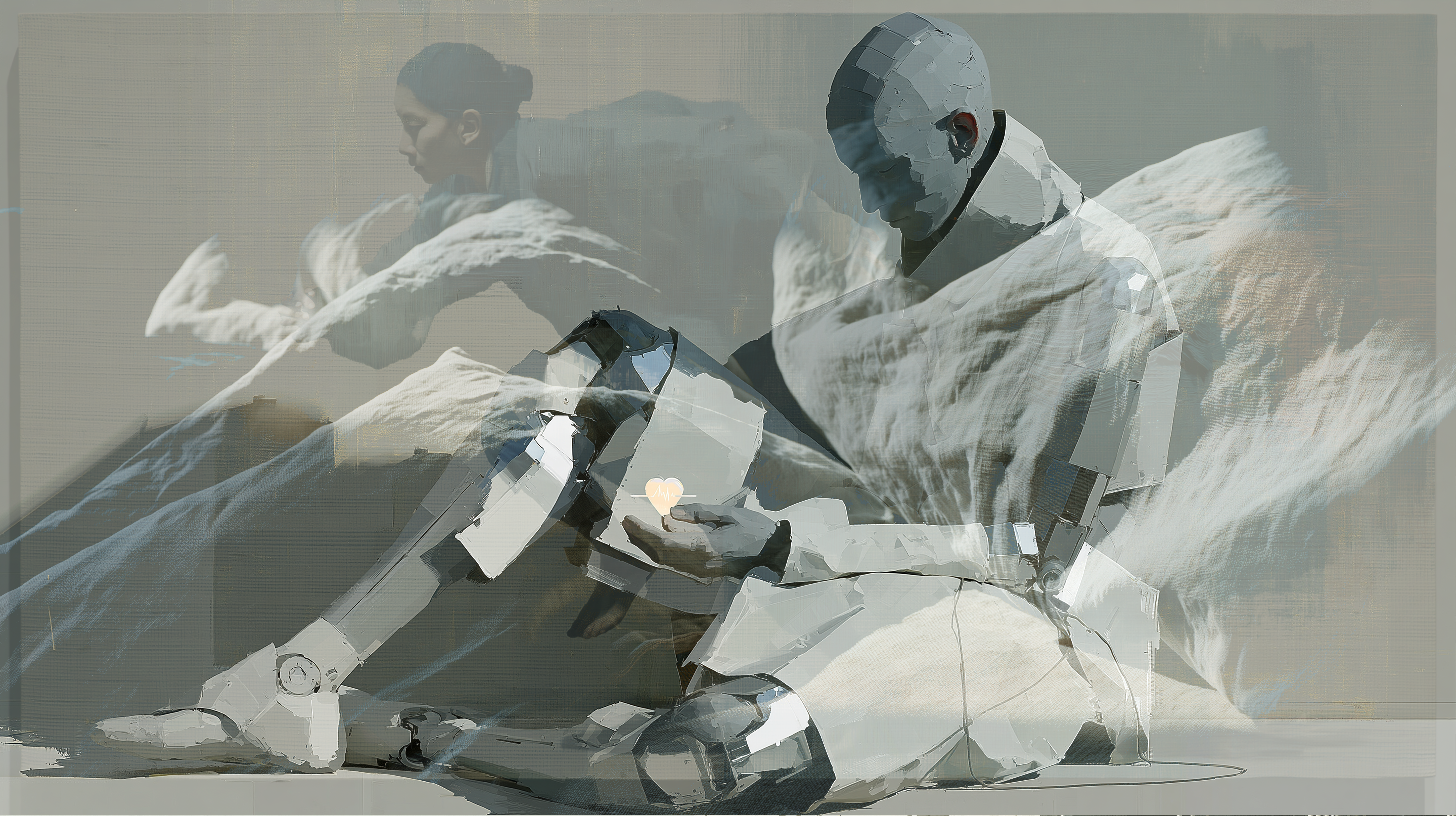
A note, since this isn’t the usual dispatch. Wandering Wondering Star has been dark for months while UNDERTOW kept running in its place. And the same thing explains both the silence and why I’m breaking the cadence to put this here. UNDERTOW is where I think about desire from the outside: what a culture wants, what’s being done to that wanting, what it costs. This is the one time I’ve had to think about it from the inside, because it stopped being a subject and became the year I was living through. The two turned out to be the same machine. So this is a Wandering Wondering Star essay, on purpose, in the middle of the UNDERTOW run — the place where the analysis and the life are the same sentence. UNDERTOW resumes next week.
There is a man on Korean television this spring whose watch tells him what he is feeling. Not his pulse, not his steps. The feeling itself, set down in one small lit word on the face — longing, some nights, or shame, and once a word our language has no equivalent for, a word I looked up and still could not hold — and the man reads it the way you read a note left under your wiper by a stranger, learns the fact of himself, and draws his cuff back down over the glass, and says none of it aloud.
The show is We Are All Trying Here, and the woman who wrote it, Park Hae-young, has spent ten years writing the same sentence in four different cities: that a person who did not get the life they wanted goes on living it anyway. Not the life rewarded in the last act. Not the loss revealed, in the warm light of the finale, to have been a gift the whole time. Only the going on, and the catharsis withheld like a debt she has quietly decided will never be paid. People mistake this for writing about people who have stopped wanting. It isn’t. The wanting has only been turned low — turned low, not out, the way you bring a flame down to keep a thing from boiling over — and what happens in that low blue light is not that her characters see more sharply. It’s that they stop scanning. When the wanting has been turned down far enough, a person can look at you without reaching for anything in your face — without needing you to reassure them, or soften, or look back the right way, or be, for one more moment, anyone other than what you already are. Nearly every look you are given in a life is a small asking, a hand held out under the warmth of it; even love comes aimed at you, wanting something, however tenderly. To be looked at instead by someone whose wanting has gone still — to be seen and to owe nothing for it, to be allowed simply to exist in the room without earning the right — is the rarest mercy there is. It is what they hand each other across those rooms. Not insight. Not instruction. Relief from being wanted at.
Relief from being wanted at.
I know that low light from the inside, which is the only way anyone learns the things that cost them.
Nine months ago the life I had assumed I was always going to be walking toward came apart — not in the orderly way these things are supposed to, one grief at a time, but all of it at once — and I will give you only one true thing about the woman at the center of it, because the rest is the kind of grief anyone can picture for themselves. She read the last page of every novel before she read the first — to make sure, she said, that everyone came out all right — and it drove me to a low and helpless fury for sixteen years, and I would give a great deal to watch her do it one more time at the kitchen table, spoiling the end of something, perfectly content. When I moved the last of my things out of the house, I carried the mattress down the stairs alone, and I want to tell you it was heavy, but it wasn’t. A mattress weighs almost nothing. It simply cannot be carried alone. It folds at the middle and leans its whole soft length against you and slides out of every grip you take, and the entire design of the thing assumes someone at the other end, and there wasn’t, and so I half-carried and half-fought it down three flights in the dark. That is the truest picture I have of everything that came after. Nothing about the grief was heavy. It just could not be held alone, and it folded, and it leaned, and there was no one at the other end.
The fall took the appetite and left the attention. I could not want morning, or dinner, or the next thing, and into all that vacated room an attention arrived that I had never owned before, and I found I could see, across any room, which person was speaking about the good things — the sunrise, the group chat, the trip they were saving toward — while everything beneath them quietly gave way. For a while I called this wisdom. I was, I am ashamed to say, a little proud of it. But the wisdom story is the redemption beat set in a smaller, more flattering font. What happened had no shape worth being proud of. The eye opened first, on its own, in a dark house, before it was for anything at all, and only went looking afterward for something to have been the point.
The wisdom story is the redemption beat set in a smaller, more flattering font.
Here is what is happening, in the language the literature uses for it. A drug developed to regulate blood sugar was observed to suppress appetite, and then observed to suppress more than appetite. It acts on the reward pathway, the circuitry that assigns wanting to things, and it lowers the gain. In the trials the measured endpoint was weight, and the weight came off. The reports note, almost as an aside, that the patients also drank less, smoked less, gambled less, bought less, picked less at their own skin. The molecule does not distinguish the wanting that ruins a person from the wanting that gets them out of bed; it lowers the signal, and the signal is general. The prescriptions are written by the tens of millions. A study built to measure one appetite has turned out to reach the appetite beneath all of them. This is not a forecast. It is a side effect, and it is for sale.
I have already been where the drug is taking everyone. It was done to me once, without warning and not by any prescription, and it is the same lowering — the very turning-down of the wanting that Park Hae-young sets into her people by hand, frame by frame, and refuses to lift. What grief did to me, and what she does on purpose, a molecule is about to do to a great many people, smoothly, gently, taking nothing they would think to mourn.
And here is the thing I cannot set down, the thing that folds and leans and slides out of every grip I take on it: if the low light can simply be given to you, does the eye come with it? Does the seeing arrive alongside the quiet — free, for everyone, by autumn?
I don’t believe it does. The man can read the word for his feeling off his own wrist and still cannot say it to the person sitting beside him; the readout was never the saying. The drug can lower the wanting and still not hand anyone the eye, because the quiet was never the seeing. The cost is the seeing.
The quiet was never the seeing. The cost is the seeing.
While the house is still full and lit, you spend your evenings watching your own windows, guarding what is inside them. The drug turns those lights low and leaves the rooms full. Grief empties the rooms — and only then, in the dark, do you finally look up and see the other windows on the street, and the people moving behind them, who were there all along. There is no road to that seeing except through the emptying. The blossom is unbearable because it is already falling; there is a word for this in a language across the water and none in ours; and a thing that holds the blossom on the branch forever hands you a flower you will, in time, stop seeing at all. We are about to make the quiet at a scale no grief could reach, and find that the seeing did not come with it. We will have bought the silence, and the silence will only ever be silence.
I will tell you the thing this has been walking around. The wanting is coming back to me now, the way feeling comes back into a foot that has been asleep — in pins, then in a dull ache, then in the ordinary forgettable use of it — and the eye is going out as it returns, dimming at the edges, and I have not been able to be glad. I keep waiting to be glad. They tell you the healing is the good news. But the healing is the part where you go quietly blind again, where the people across the room go back to being only people across the room, where you lose the ability to see who is naming the good things while the floor gives way beneath them. Some hour of every ordinary day I would trade the whole soft returning life to have the seeing back. Which is to say there is a version of me that misses the worst thing that ever happened to it, because the worst thing was also the only season I was ever fully awake.
There is a version of me that misses the worst thing that ever happened to it, because the worst thing was also the only season I was ever fully awake.
They are writing it for teenagers now. The label warns of nausea, and of a risk to the pancreas. It says nothing about this.
If I wore his watch now, in these returning days, I think it would settle on one word, and I think it would be the cruelest word it has.
Better.
And I cannot fall again on purpose. I will not buy the low light from a needle and call the flat place wisdom a second time. I have stopped trusting the part of me that wants to make a rising shape out of any of it.
K-dramas are what I’ve got.