

If you’ve never scrolled Xiaohongshu, the interface looks like Instagram rebuilt by someone who thinks you deserve more information. Product reviews arrive as short videos, and the good ones have a texture you learn to read: the pause before the verdict, timed to feel spontaneous. You learn to not trust what you can’t decode.
Last year, something broke the pattern. AI-generated product reviews, clearly labeled as such, started being trusted more than the influencer content surrounding them. Not because anyone thought the AI was smarter. Because the label was honest about what it was. The humans were performing sincerity. The AI had declared itself. And somehow, in that particular feed, the declared thing was easier to trust.
I’m a creative director. Twenty-five years, starting at the first commercial internet and arriving at whatever this is. In my personal life, I make things with AI every day. And the Xiaohongshu inversion keeps me up because it suggests something I don’t want to be true: that in the emerging hierarchy of trust, the question isn’t “was a human involved?” It’s “can I read the conditions of making?” Not authenticity. Legibility. And those are not the same thing, even though I spent most of my career assuming they were.
There’s a scene in the first episode of Tokyo Land Swindlers where a forger prepares to sign documents that will steal a building from its owner. The detail that stopped me: he applies a thin, transparent film to the pads of his fingers before touching anything, so the forged documents carry fingerprints. Not his. Fabricated ones. Prints that would satisfy anyone checking whether a human being had actually been there.
I watched the scene twice, and both times I recognized the craftsmanship in a way that made me uncomfortable, because what is a good pitch deck if not a set of traces arranged to convince a room that a certain kind of thinking happened? I’ve been building those traces for two decades. I know the tells. The slightly imperfect formatting that says “I was moving too fast to fuss with this because the idea was more important.” The personal anecdote timed to land after the third strategy slide. The question planted on slide seven that the deck answers on slide twelve. Fingerprints. Not fake, exactly. But... arranged.
Not the document. The traces on the document. The pressure of the pen, the oil from the skin, the evidence that a specific person was present at a specific moment and made a specific choice. We read the parts of the object that have nothing to do with its content, and everything to do with the conditions of its creation.
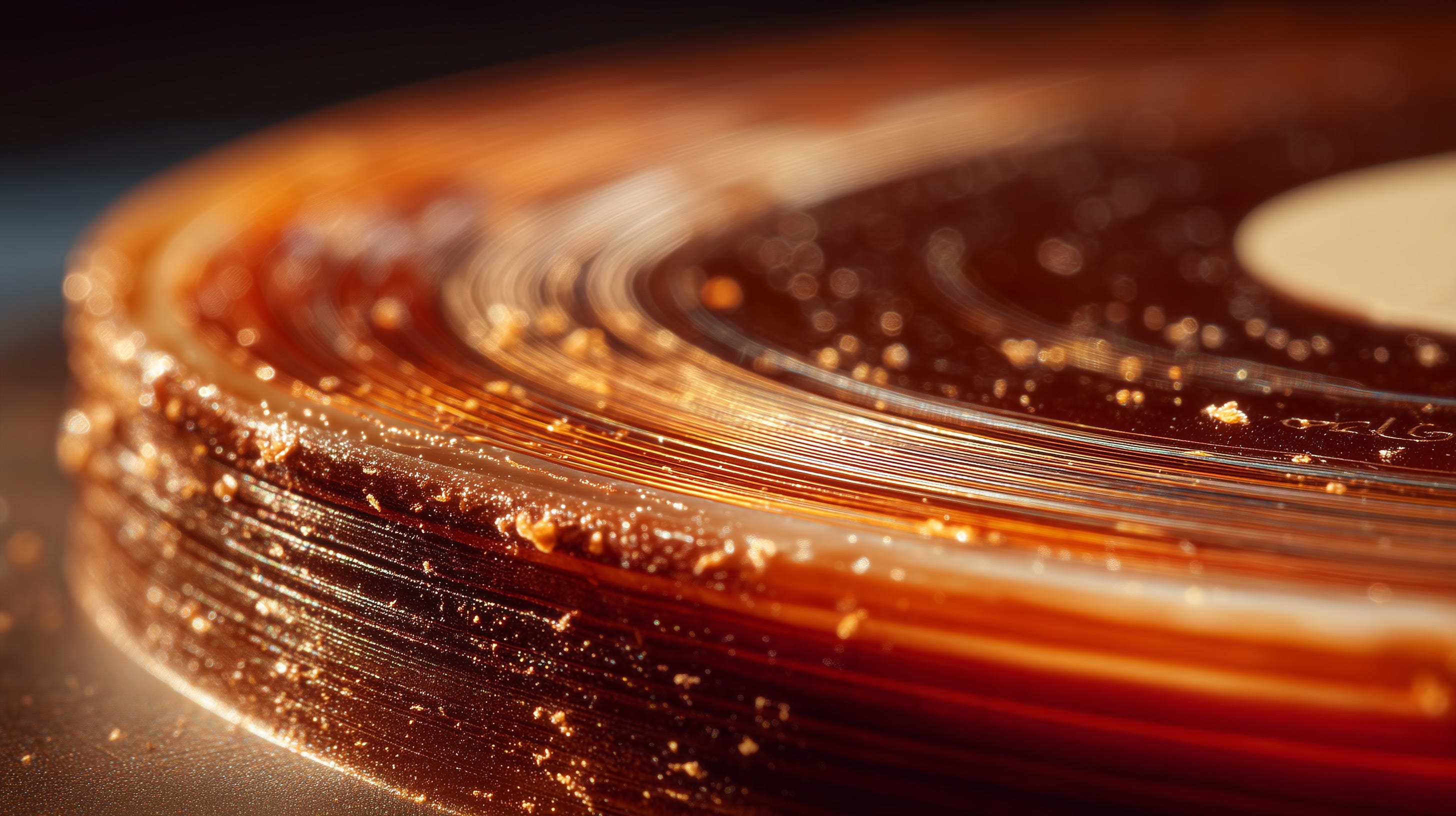
In the vinyl world, they have a name for this space. They call it the dead wax.
The dead wax is the smooth, silent band between the last song and the paper label at the center of a vinyl record. Nothing plays. But etched into that silent space, in markings so small you have to tilt the record under a light to read them, is the true story of how the record was made. Matrix numbers identifying the specific metal stamper. Engineer signatures hand-engraved with a pantograph. Pressing plant codes. Take numbers.
George Peckham, a mastering engineer in the UK, etched hidden inscriptions in the dead wax of every record he touched for decades. “A Porky Prime Cut,” most of them read. Sometimes he’d scratch in a phone number and hope someone would call. An Australian hardcore band called the Hard-Ons etched: “What the fuck are you looking at? There’s no secret message here you stupid prick!”
The dead wax plays silence. And it’s the only part that proves who made it.
Reading the dead wax means knowing the difference between a genuine first pressing and a counterfeit that copied the matrix numbers but got the depth wrong. The cover can fool you. The label can be reprinted. But the metal stampers leave a fingerprint in the runout groove, and reading it takes the kind of knowledge that only comes from having held a thousand records in your hands.
I haven’t held a thousand records. I’m using dead wax as a frame because the structure maps onto a problem I’m living inside, not because I’m a collector. A collector would find my understanding shallow. That gap is its own kind of dead wax: traces of where my knowledge comes from and where it stops.
The dead wax plays silence. And it’s the only part that proves who made it.
AI generates the groove, the output, the content, the thing you came for. A million copies from a single prompt. What it does not generate is dead wax. No evidence of circumstance. No trace of a specific hand, no residue of what it cost the maker to make the thing.
Alex Blania is spending $250 million on metallic orbs that scan your irises to confirm you’re human. Proof of human: a binary gate. I understand the appeal. I’ve spent months trying to build my own version of that gate. But a binary gate is a groove detector. It tells you the record exists, not who pressed it. And the Xiaohongshu users have already moved past the question it answers.
This September, the Chinese government formalized the Xiaohongshu instinct into law. Every major platform now labels AI-generated content with visible markers and hidden metadata: watermarks invisible under normal conditions, revealing the origin when examined with the right tools. An analyst in the *Global Times* called them “a content passport.”
China is building dead wax for digital content. Mandatory etchings.
George Peckham’s etchings weren’t mandated. He scratched “A Porky Prime Cut” because he’d spent his life at the lathe and the runout was the one space on the record that belonged to him. Voluntary. Personal. A byproduct of care.
China’s content passport is compliance. Manufactured provenance. Regulatory etchings that look identical to organic ones under the right light but record nothing that happened to a person. The forger’s transparent film applied at industrial scale, except the purpose is transparency rather than deception, which makes it better in one way and more unsettling in another.
Manufactured provenance and organic provenance are not the same thing. The question is whether that distinction matters to anyone besides people already in love with the idea of the irreducible human trace.
On Xiaohongshu, it doesn’t seem to. Legibility is enough. The users don’t care if the etchings were carved by hand or stamped by regulation. They care that the etchings are readable.
So maybe the dead wax framework is wrong. Maybe it describes what matters in rooms where people have handled enough records to read the runout groove, and it describes nothing at all in feeds where the volume is too high for anyone to tilt anything under a light. I started writing this essay believing I had an argument. The argument is now sitting across from an observation that contradicts it, and I can’t make them shake hands.
And the argument’s failure and my own, feel, tonight, like the same thing.
It is almost midnight on a Saturday. My feed is half videos of war, half of Thomas Bangalter grinning like the happiest man alive at the end of his set with Fred, having just performed without a helmet for the second time in sixteen years. I’m on the floor of my apartment because the desk chair has a wobble I keep meaning to fix and the floor is more honest about its limitations. My left shoulder is doing something it shouldn’t, a pec injury I’ve been ignoring the way you ignore things that would require you to stop doing the thing you love. I made spaghetti with too much garlic and not enough salt because I was thinking about this essay instead of the food.
I’ve been trying to verify myself for months. To friends, to my therapist, to the mirror, to you. The dead wax framework is, if I’m being honest, my latest attempt: a way to argue that there’s still an irreducible me underneath all the shifts, readable by the right instrument under the right light. A marriage ended. A career changed shape. And then the tool I use every day started making it hard to tell which thoughts were mine. The framework cracking feels personal because it is.
I’ve been a creative director for twenty-five years. This essay was researched by a language model. The outline was collaborative. The panel that stress-tested the conceit was generated: a forensic document examiner from Lagos, a mastering engineer from Tokyo, a microbiologist from Hokkaido. None of them exist. I’m telling you that now because the essay argues legibility is what matters, and I notice that practicing legibility feels worse than preaching it.
practicing legibility feels worse than preaching it.
Here is the thing I have not said yet.
I don’t always know which sentences are mine.
I chose every word. But when you work with a system this fluid, the boundary between your thinking and the model’s suggestions gets soft. You ask it to research something. It returns a frame you hadn’t considered. You reshape the frame, write it in your voice. Except the initial shape came from somewhere else, and by the third iteration you can’t reconstruct the genealogy. Did I think of the Harris lines connection or did the model surface it? I don’t remember. After the first few months, I stopped caring.
A man on a floor writing about human fingerprints while using a system that has no fingers. I know the situation is absurd. I’m choosing not to resolve the absurdity because resolving it would be another kind of transparent film, a surface arranged to look like coherence where the actual condition is incoherence.
There is a subculture called grinders: biohackers who implant technology into their own bodies. They gather at Grindfest in the Tehachapi Mountains, where a nurse named Jeffrey Tibbetts performs procedures in his garage. A woman known as Anonym started at nineteen by cutting a hole in her finger with a scalpel and holding the wound open with a sterilized potato peeler to insert her first magnet.
The grinder’s scar is its own dead wax. Not the implant. The scar: tissue that formed involuntarily as the body recorded having been opened. It doesn’t prove the implant works. It proves the person was willing to be cut.
Your bones carry a similar record. In forensic anthropology, Harris lines are dense horizontal bands that form in long bones when a child’s growth stops under severe stress. You can’t manufacture one. You can only endure the conditions that produce one. Every illness survived, every season of scarcity, etched into your skeleton in markings that play silence, readable only by someone trained to look.
I think about my own bones sometimes now. What an X-ray would show. Whether the last six months left a line.
The first essay I wrote in this series, “Unfermented Base Notes,” used the architecture of perfume: base notes that take hours to arrive, that can’t be rushed. The argument was that depth is real and that the people who still read dead wax can tell.
One of the panelists who stress-tested the Dead Wax conceit challenged that argument in a way I can’t shake. She’s a microbiologist who studies fermentation ecology. (She’s synthetically generated. I’m telling you now rather than later.) Her grandmother maintained a sourdough starter in Hokkaido for over two hundred years. When the grandmother died, the microbiologist sequenced the starter and found bacterial strains that no longer exist in the wild. They’d co-evolved with the family’s kitchen, hands, climate, over generations. Irreproducible. You could culture something similar. You could never recreate the exact community that two centuries of daily practice had produced.
Her challenge: dead wax is static. Etched once. But you’re still being made.
She called it living dead wax. A culture that records its own history in its own body. Unreplicable because still in process.
I think that’s what you detect when you sit across from someone and take their measure. Not a credential or a portfolio. A living culture. Something still fermenting, still marked by every kitchen it’s passed through. Base notes that haven’t finished arriving because the fixation is still happening, because you’re still alive, because the work isn’t done.
If my dead wax is living, still fermenting, then the conditions of its making now include a system that has no dead wax of its own. Every conversation with the model is in the starter. Every frame I reshaped, every sentence whose genealogy I can’t reconstruct. I can’t remove it any more than you can remove a bacterial strain from a two-hundred-year-old sourdough without killing the culture.
The framework says the proof is in the human trace: the circumstances of making, the evidence that a specific person was here and it cost them something. I believe that. It’s why I told you about the floor and the shoulder and the garlic. It’s why I told you what’s been shifting.
But my human trace now includes etchings I didn’t make alone, made alongside something that leaves no etchings of its own, in a process where the line between my contribution and its suggestions has become, in places I can’t always find, irrelevant.
I’ve tried to make this essay’s making as legible as I can. The generated panelists, declared. The collaboration, disclosed. The personal circumstances, offered. The uncertainty about authorship, admitted.
And I still don’t know if it’s enough. Not enough to persuade you. Enough to be true. Because the most legible account I can give still contains a gap I can’t see into: the place where my thinking and the model’s became one fermentation.
a transparent film you can’t tell if you’re wearing.
Maybe that’s the dead wax of this particular moment: a transparent film you can’t tell if you’re wearing.
I made this. I don’t know what I made.