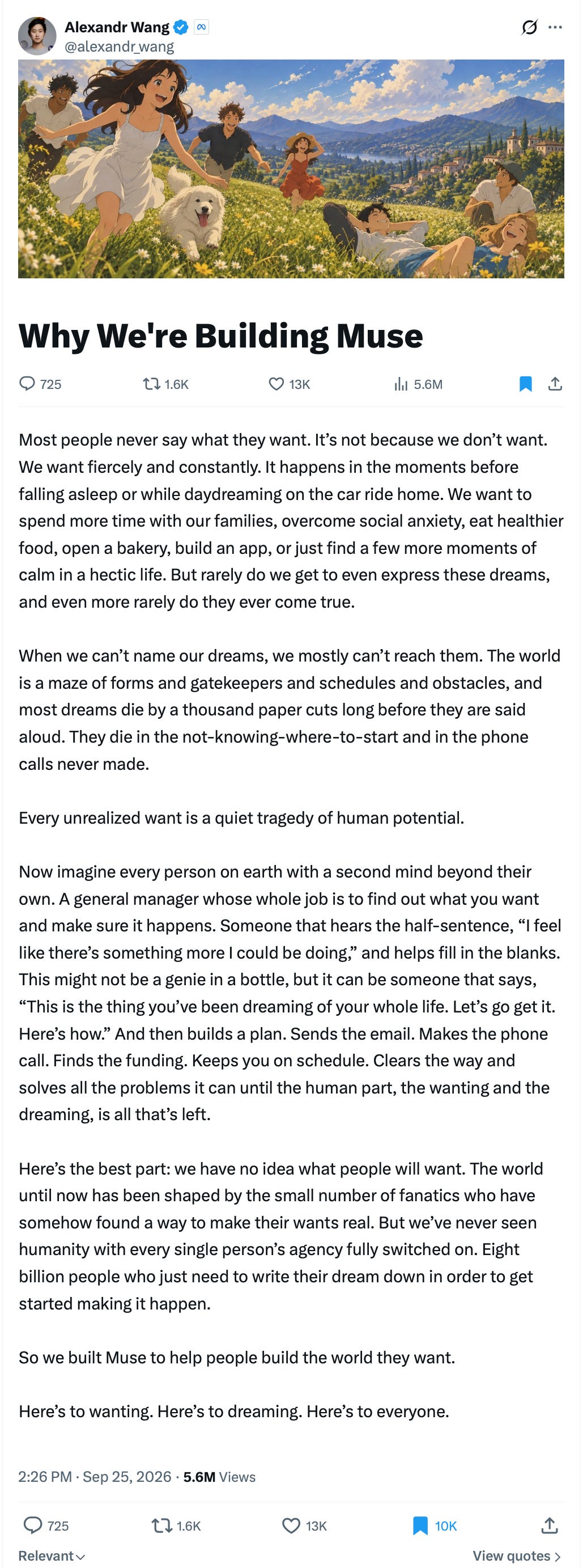
Instinct and Muse came out at last month. I started writing this the day after Wang posted about why he built it. Then it took a while. Because I got busy trying to figure out what I want.
Alexandr Wang runs Meta’s AI lab, and at the end of September he published a short post on X about why he’s building Muse, the personal assistant. The strongest part is where he starts. The trouble with wanting, he says, isn’t a shortage of it. People want all the time, and hard. The trouble is that most people never say what they want, and a dream you can’t name is one you mostly can’t reach.
So the product isn’t a chatbot. He describes a general manager for your life, someone whose only job is to find out what you want and then make it happen. It hears you say you feel like there’s more you could be doing, and it helps you fill in the rest. Then it tells you this is “the thing you’ve been dreaming of your whole life,” builds the plan, sends the email, makes the call, finds the money, keeps you on schedule, and clears what’s in the way, until the only part left for you is the wanting and the dreaming.
I think that’s a real promise, and one of the biggest anyone shipped this year. The hard part isn’t the emails. It’s the sentence that comes before them, the one that says what you want.
In his post, the person who says it keeps changing. At the start it’s you: say your dream out loud and you can go get it. In the middle it’s the assistant: you get half a sentence out, and it helps fill in the rest. At the end it’s you again: eight billion people writing their dream down. His post is only three hundred words, and the job of saying what you want goes from you, to the machine, and then back to you. I don’t think that’s a trick. I think it’s a builder being honest about the one part of this product that isn’t built yet.
Who writes the sentence that says what you want?
Right now, the assistant writes that sentence for you, in seconds. It’s late, and you type the line from Wang’s post, “I feel like there’s something more I could be doing,” and you stop, because that’s as far as you’ve ever gotten. You do not know what to do. You’ve never figured it out. The assistant has read your calendar, your inbox, your saved reels, and six months of what you lingered on, and it finishes the sentence before you can. You’ve been pricing studio apartments across the river, where the rent finally works. The version of you that moved to this city would call that quitting. The version of you that has moved enough times to know better keeps the tab open anyway, and hates that the sensible move and the one that would break something in you are the same move. You’ve opened the same job listing at a frontier lab four times, closed it four times, because on paper you’re not qualified, and the paper is the only part of you it can see. Here’s the rest of your sentence, it says. Stop. Don’t you realize that twenty years of strange jobs actually made you the person who’d walk in and win that one? Want me to start your application?
That’s the assistant Wang’s post promises, the one that finishes the sentence you never could. Here’s the one Meta actually shipped. When Meta launched Muse, its ad showed the logo surrounded by things the assistant might say to you. One of them:
“Halloween is coming up. Want me to order costumes?”
That’s it. That’s what they chose to show you. You gave it your calendar, your inbox, every reel you saved at 1 a.m. and six months of what you lingered on, and the payoff they picked is the one want you could have gotten from a Duane Reade window. Not the river. Not the job. A holiday, a shopping cart, and a bright little “want me to,” the voice of someone who’s already put it in the cart and is asking so you’ll feel consulted. And it’s never once wrong, because who argues with a costume? One yes, and it’s ordered.
That’s what Meta chose to show you: a plausible sentence about you, fast, polite, and easy to say no to. It costs the machine almost nothing to make. For most of your life that sentence was the expensive part of being helped. Someone had to hang out and watch you for years before they could clock that one true thing about you in one line, and the people who could were a short list: a sister, a best friend, an ex who’d earned the right. Now it takes seconds, and the thing saying it met you last Tuesday.
Now it takes seconds, and the thing saying it met you last Tuesday.
What hasn’t sped up is the other half: finding out whether the sentence is true. You check a want by trying it and seeing if you have buyer’s remorse later, or by waiting and seeing if it’s still there. Both take the kind of time the sentence didn’t. The assistant can cut the wait for “you want this” to nothing. It can’t cut the wait for finding out.
The sentence that says what you want now arrives in seconds. Finding out whether it’s true hasn’t sped up.
People have paid for a sentence about themselves for a very long time. Not for the sentence to be right. For the sentence to be about them.
Korea is the cleanest place to watch it this year. Fortune-telling there is ordinary, not fringe. A national survey the Seoul Economic Daily cited in April found that about six in ten Koreans have used a fortune teller, and the reason they gave most often wasn’t direction. It was relief from being anxious. One shaman who appeared on a Disney+ show is booked until 2029. But the number that matters is the other one: seventy-three percent said they take from a reading only what they think is worth hearing, as reference. They walk in for a sentence about themselves and walk out treating it as a draft.
They walk in for a sentence about themselves and walk out treating it as a draft.
The paper quoted a 31-year-old office worker, weighing marriage and a job change, who sees tarot readers on weekends. The cards don’t give you the answer, she said. They help you sort out what’s already in your heart.
That’s what she goes back for on weekends, and it isn’t an answer. It’s a sentence she can fidget with on the ride home and pick apart later, and the person who said it never finds out which parts she kept.
Not a verdict. Material to sort.
Muse finds out. That’s the difference. It remembers what you said yes to. Her reading ends after she pays. Muse’s sentence ends with an offer.
Meta built a pause that Wang didn’t write. In his post, the assistant just sends the email. In the product, Meta says Muse checks with you before it sends an email or spends your money, and you can set how often it speaks up on its own. That’s a real choice, and a decent one. But look at what the pause is. It’s “Want me to?” The whole step where you find out whether you meant it, shrunk to the length of a tap.
Except sometimes the tap is how you find out. Maybe you’d never have sent in that application because you had no encouragement. Starting it might be the only way to learn whether you want the job at all. A lot of what people want, they discover by doing something a little too early and noticing how it feels. An assistant that gets you to the interview faster could be the best thing that happens to your wanting.
So the trouble isn’t the help. It’s that the yes takes a second, and finding out whether you meant it means living in it: the first month’s rent across the river, the third Monday at the new job. By then your yes is already part of what Muse knows about you, and nothing in a tap tells it you were only trying it on. “Help me find out if I want this” and “help me get this” can look like the same yes.
A yes tells it what to do. It doesn’t tell it what you meant.
In the summer of 2023, a song called “Super Shy” by the K-pop group NewJeans was a hit. It’s about someone too shy to say what she feels, who works up the nerve to say it anyway. The whole song is that effort. Nobody says it for her.
That’s Wang’s first line with a beat under it: most people never say what they want. But the song doesn’t fix the problem by handing the line to someone else. Getting the words out is the point. It’s how she finds out she means them.
Muse would probably be right about you. It would guess you’d enjoy the studio, the job, maybe even the costume. Guessing what you’ll enjoy is what these systems are built for. It’s how your feed works. Knowing where the enjoyment leads is a different job, and part of that job is being the one who said it.
In a study posted online this spring, a team of researchers had 470 people set personal goals. Some wrote their own. Others got goals an AI wrote from their own notes about what they wanted. The AI’s goals were better by the checklist your boss uses at review time: more specific, easier to measure, with real deadlines. Two weeks later, about three in four of the people who wrote their own goals had acted on at least two of them. Fewer than half of the people handed the AI’s goals had. The AI’s goals weren’t worse. People just didn’t feel those goals were their own. That feeling dropped most for the people least sure of themselves.
Saying it yourself is part of how you find out you meant it.
Wang ends his post with eight billion people who just need to write their dream down to get started. I think he’s right, and it’s the one sentence in his post that his product can’t do for you.
So, back to the question this started with. Who writes the sentence that says what you want? Anyone can help with a draft: a fortune teller, a friend, a machine that met you last Tuesday. What only you can do is say whether it’s still a draft, and finish it. Most of us get as far as “I feel like there’s something more I could be doing.” The part that counts is the rest of it, the part you’ve never said out loud. It doesn’t even have to be a good version. Everything after that you can hand off: the plan, the email, the money, the schedule. That’s what the thing is for.
Here’s the test I’d use. Before you tap yes, ask how long it would take to find out you were wrong. If it’s a night, tap. Let it order the costume, book the table, find the cheaper flight, start the application. If it’s a year, or a life, like moving into the more affordable but soul-compromising apartment across the river or saying yes to the job whose posting you’ve closed four times, stop. Don’t let anyone or anything finish that sentence for you. Say it out loud first, badly, to someone who’ll ask what you meant.
If being wrong costs you a night, let it finish the sentence. If it costs you a year, finish it yourself.